
How to Grow a Comedy Podcast With Clips

A comedy podcast grows when its clips make strangers laugh with zero context, so treat the clip, not the episode, as the product you ship. Cut the funniest 20-to-45-second moments that stand on their own, lead with the line that earns the first laugh inside three seconds, and post three to five a week. The bit that kills in the room is often the one that dies on a phone; engineer for the phone.
That is the whole shift. You are not promoting episodes anymore. You are publishing comedy as short-form video, and the long episode becomes the back catalog people binge after a clip hooks them. Comedy is the most-listened-to US podcast genre (Statista), which means the audience is enormous and the competition for a scroll is brutal. Clips are how you reach the people who have never heard your name.
Clips drive an estimated 20-to-40% of new audience for video shows and can lift reach two-to-five times (Podcast Studio Glasgow). And in 2026, social media (57%) overtook friends and family (54%) as the top way listeners find new podcasts, the first time that has happened, and the researchers credit video clips for the shift (Inside Radio, reporting Coleman Insights/Amplifi data). Both numbers are directional, not guarantees, but the direction is the point.
Why comedy clips are their own product, not episode ads
A comedy clip succeeds or fails on one question a stranger answers in three seconds: is this funny right now, to me, knowing nothing? An episode trailer says "listen to find out." A clip has to deliver the laugh in the post. The moment you accept that, every editing decision gets simpler.
This is also why so much great in-room comedy never travels. The room had context, twenty minutes of a running bit, a guest the audience already loved, a callback to episode 12. The phone has none of that. Most social video is watched on mute as well (commonly cited at 75-to-85%; Verizon Media/Sharethrough reported ~75%, Digiday reported ~85% of Facebook video muted, publisher-reported and directional), so a clip that depends on tone of voice loses half its punch unless your captions carry the timing.
The fix is not to write tighter scripts. The best podcast comedy is loose and reactive, and scripting it kills it. The fix is to engineer the conditions where clippable moments happen, then cut ruthlessly. You can read more on the line-level mechanics in our guide to punchline timing in comedy clips; this piece is about the growth system around it.

How long should a comedy clip be?
Twenty to forty-five seconds for most bits, never longer than the laugh can carry. The clip needs the setup, the turn, the punchline, and a beat of reaction. Under 20 seconds you often cut the setup off and the joke lands on no one; past 45 the scroll wins before your punchline arrives.
The 30-to-90-second window is the workable range for podcast clips in general (castmagic). Comedy sits at the short end of it. A 20-minute-plus episode holds enough of these moments for a week or two of posts, treat that as an editorial rule of thumb, not a fixed count, because some episodes are gold mines and some have one usable bit.
The five steps to engineer clippable comedy
You cannot force a great bit. You can stack the deck so more of them happen, then catch them cleanly.
- Set up running formats that manufacture turns. Recurring segments, a hot-takes round, a "defend the indefensible" game, listener voicemails, a guest's worst opinion, create reliable structure where a punchline can land. A loose chat produces one clip an hour; a format produces one every few minutes because the setup is built in.
- Record video, and keep both faces on camera. Comedy travels on reactions. The co-host's face cracking is half the clip. Audio-only comedy can still clip as a captioned audiogram, but you lose the reaction shot that makes people share. Shoot two angles if you can.
- Mark the laugh as it happens. Have someone (or you) drop a timestamp the instant the room actually laughs. That live marker is worth more than any after-the-fact scrub, because the in-room laugh is your strongest signal of what will land outside it.
- Cut to the laugh, then build the front. Find the punchline first. Work backward to the minimum setup a stranger needs, usually one or two lines. Then find the very first sentence that is interesting or funny on its own and start there, even if it means rearranging. Lead with the spike, not the runway.
- Caption for timing, not just transcription. In comedy, the caption is the comic timing for the muted viewer. Reveal the punchline word at the moment it is spoken, not a half-line early, early reveal kills the joke the way a friend who blurts the ending does. Hold setup lines, then snap the payoff in.

The self-contained-laugh test
Before you post, run every clip through one question: would a stranger who has never heard your show laugh, or at least smile, by the end, with no other information? If the laugh depends on knowing a character, a callback, or a previous episode, it is an inside joke. Inside jokes reward your existing fans. They do not grow you.
This is the single biggest difference between comedy clips that travel and ones that die. The same test applies across niches, it is the core of our self-contained clip test, but comedy is where it bites hardest, because so much of what is funny live is funny because of context.
Common mistakes that flatten funny clips
- Leading with the setup. Ten seconds of "so anyway, where was I" before the joke. Start at the first interesting word. If the spike is at second 14, that is your second zero.
- Posting the laugh, not the joke. A clip of two people cracking up means nothing to a stranger who never heard the line. Keep enough of the line that the viewer is in on it.
- Over-relying on the bleep-and-shock. Crude can travel, but a clip that is only shock has no second viewing and no follow. Funny survives the algorithm; shock spends out.
- Captioning everything in one style. Comedy captions need rhythm, hold, then punch. A flat word-by-word stream with no pause flattens the timing. Match the caption reveal to the comic beat.
- Chasing one viral clip instead of a rate. One breakout feels like growth; it rarely converts. Post three to five a week so a stranger who likes one clip finds two more and a reason to follow. Virality without consistency is empty engagement, views are not subscribers.
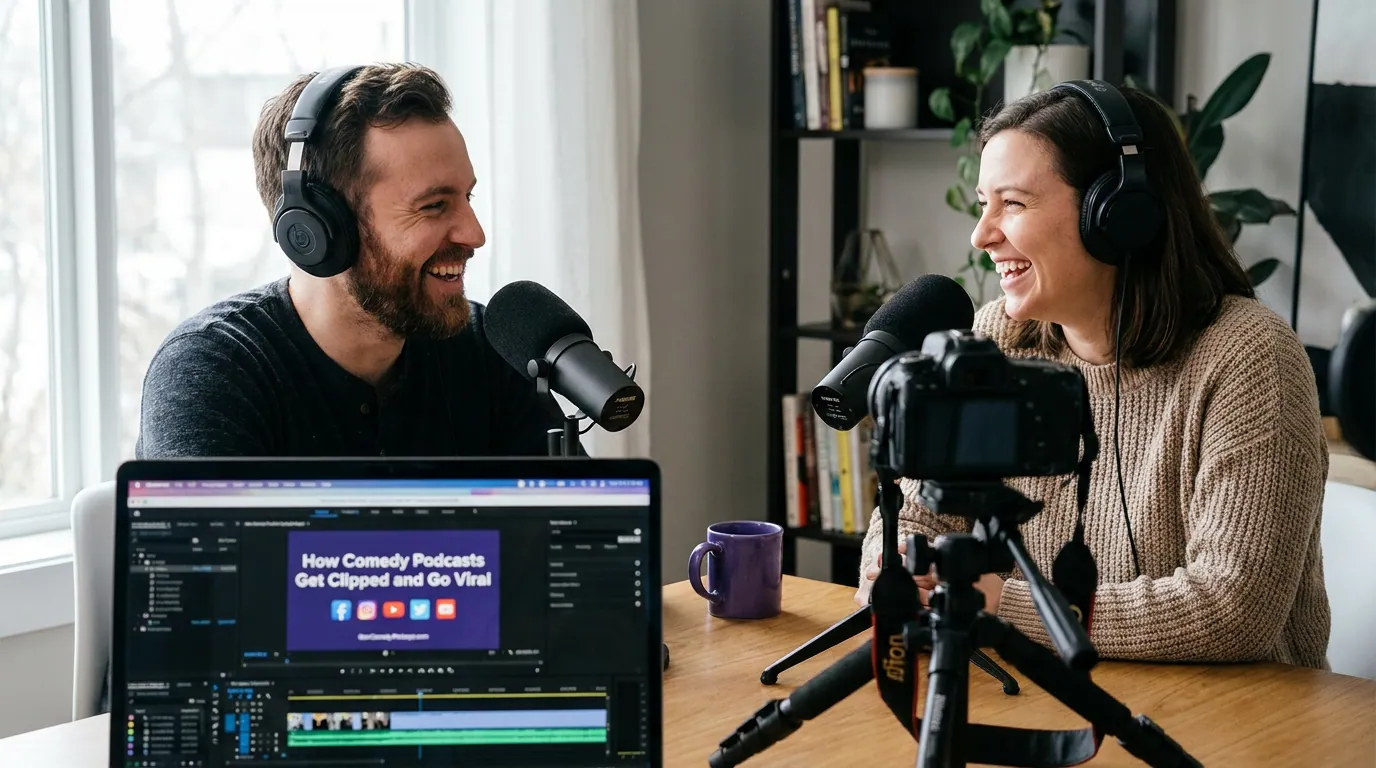
How clips actually convert into a comedy audience
A laugh earns a follow; a follow earns a listen. The clip's job is the first laugh. The rest is a path you have to build: a clear handle, a pinned "start here" episode, and a reason to leave the platform. Comedy listeners binge, give a new follower an obvious next clip and then a full episode, and you turn a three-second laugh into a habit.
This is also where an email list pays off, because platforms can throttle a page overnight and a list cannot be taken away. If you are starting from scratch, our walkthrough on building a podcast email list from zero and the companion welcome email sequence for new subscribers cover the mechanics. The same clip-as-growth-product logic applies in adjacent niches with their own ethics and formats, see how it plays out for growing a true crime podcast without crossing ethical lines and why business podcasts grow by booking guests first.
FAQ
How many comedy clips should I post per week? Three to five short clips a week is the workable range for a growing show. Below three, you rarely gather enough data to learn which bits travel; above seven, quality usually slips unless you have help. Start at three, hold the cadence, and only raise it when your view-through rate stays steady.
Can an audio-only comedy podcast still grow with clips? Yes, but with a handicap. You lose the reaction shot that makes comedy shareable, so lean harder on captions and on bits that are funny on the words alone. A captioned audiogram of a sharp one-liner can travel; a clip of off-camera laughter cannot.
Why do my best in-room bits flop as clips? They almost always depend on context the room had and the phone does not, a running joke, a callback, a guest the audience already loved. Run every clip through the self-contained-laugh test: would a stranger laugh knowing nothing? If not, it is fan service, not a growth clip.
Do swear words and shock value help comedy clips travel? Sometimes for the first view, rarely for a follow. Platforms also suppress some flagged language, and a shock-only clip has no replay value. Build clips around an actual joke; let the edge be seasoning, not the meal.
Should I edit comedy clips by hand or use AI clipping? AI clipping is the fastest way to surface candidates and add captions across a full episode, but every AI clip still needs a human pass, and comedy needs the most, because timing is the whole game. AI does not know where the laugh actually peaks. Let the tool find and caption the moments; you make the final cut on the laugh.