
Why Business Podcasts Grow by Booking Guests First

The fastest way to grow a business podcast is to chase the right guests, not more listeners. A well-chosen guest arrives carrying their own email list, following, team, and customers, and the good ones bring that audience with them when the episode ships. So the growth question is not "how do I get found?" It is "whose audience am I borrowing this week, and how hard will they share?" Pick guests by their reach and willingness to promote, and distribution comes built in.
This is the move most B2B shows miss. They pour effort into SEO titles, posting schedules, and cover art while booking whoever says yes, then wonder why a year of episodes sits at a few hundred downloads. The episode is not the product. The guest's relationship to their audience is the product, and the interview is just the reason they activate it. This guide gives you the mental model (a guest is a distribution node), the way to rank prospects (a guest-ROI score), the math behind why overlap matters, and a six-week plan to turn one founder interview into recurring inbound.
Why does booking guests grow a business podcast faster than chasing listeners?
Booking guests grows a business podcast faster because each guest is a distribution channel you do not have to build. Chasing listeners earns attention one person at a time; booking a guest with a 20,000-person email list borrows 20,000 warm contacts at once. And B2B guests, unlike most consumer ones, have a professional reason to broadcast the episode.
The arithmetic is brutal for the listener-chasing approach. Nearly half of all podcasts stop at three episodes or fewer Amplifi Media, and a big reason is that growth from cold discovery is painfully slow, most shows never accumulate enough audience to feel worth the effort. Guest-led growth front-loads the audience instead of waiting for it. Every episode launches in front of someone else's followers, so even a small show compounds from week one.
There is a discovery shift underneath this too. 57% of listeners now rely on social media for podcast recommendations versus 54% on friends and family (InsideRadio, "The State of Video Podcasting 2025"), the first time social passed personal referral. Guests are the most efficient way to ride that channel, because when a guest posts the episode to their feed, you inherit their social distribution, not just their podcast audience. You are not competing for a slot in the charts. You are showing up, pre-vouched-for, in a feed that already trusts your guest.

How do you pick which guests to chase? (the guest-ROI score)
Rank every prospect on four things before you pitch: reach (how big is their audience), overlap (how much of it is your buyer), willingness (will they actually share), and topic fit (do they have something specific to say). Score each one to five, total it, and pitch the top of the list first. Willingness and overlap beat raw fame.
Most hosts book on fame alone, and it backfires. A CEO with 200,000 followers who treats your show as a favor and never posts the episode delivers less than a mid-level operator with 8,000 engaged followers who reshares it three times and emails their list. Reach is only potential audience. Willingness is what converts potential into actual reach, and it is the variable everyone ignores.
How to read the score in practice:
- A 16+ total is a drop-everything pitch. High reach, high overlap, and they share, book them, prep hard, and build the whole month's distribution around the episode.
- Willingness under 3 caps the whole score. A guest who will not promote is worth roughly their walk-in audience, which for a small show is close to zero. Be honest about this before you spend a week chasing them.
- High overlap can outrank high reach. A niche operator whose entire 5,000-person list is your buyer is worth more than a generalist with 100,000 followers who barely match your category. The overlap math below is why.
The audience-overlap math (why a smaller, closer guest wins)
Overlap is the fraction of a guest's audience that is actually your buyer, and it usually decides the real return more than raw reach does. A guest with 100,000 followers at 3% overlap delivers 3,000 relevant impressions; one with 10,000 followers at 60% overlap delivers 6,000. The smaller, closer guest wins, and their audience is warmer.
| Guest | Reach × overlap | Relevant impressions |
|---|---|---|
| Famous generalist | 100,000 × 3% | 3,000 |
| Adjacent operator | 30,000 × 20% | 6,000 |
| Tight-niche peer | 10,000 × 60% | 6,000 |
The numbers above are illustrative, not measured, the point is the shape, not the exact figures. Run your own estimate per prospect: guess their reachable audience, guess what share of it buys what you sell, multiply. You will repeatedly find that the guest who feels like a smaller "get" is the better business decision. This is especially true for shows in trust-heavy categories, where a vouched-for niche endorsement converts far better than broad exposure, the same dynamic that drives growing a personal finance podcast people actually trust.
There is a compounding effect that does not show in a single row. Niche guests know each other. Book one well-respected operator, treat them well, and the next three pitches get easier because you can name-drop the first, overlap networks refer within themselves. Reach networks rarely do.
How do you turn one founder interview into six weeks of inbound?
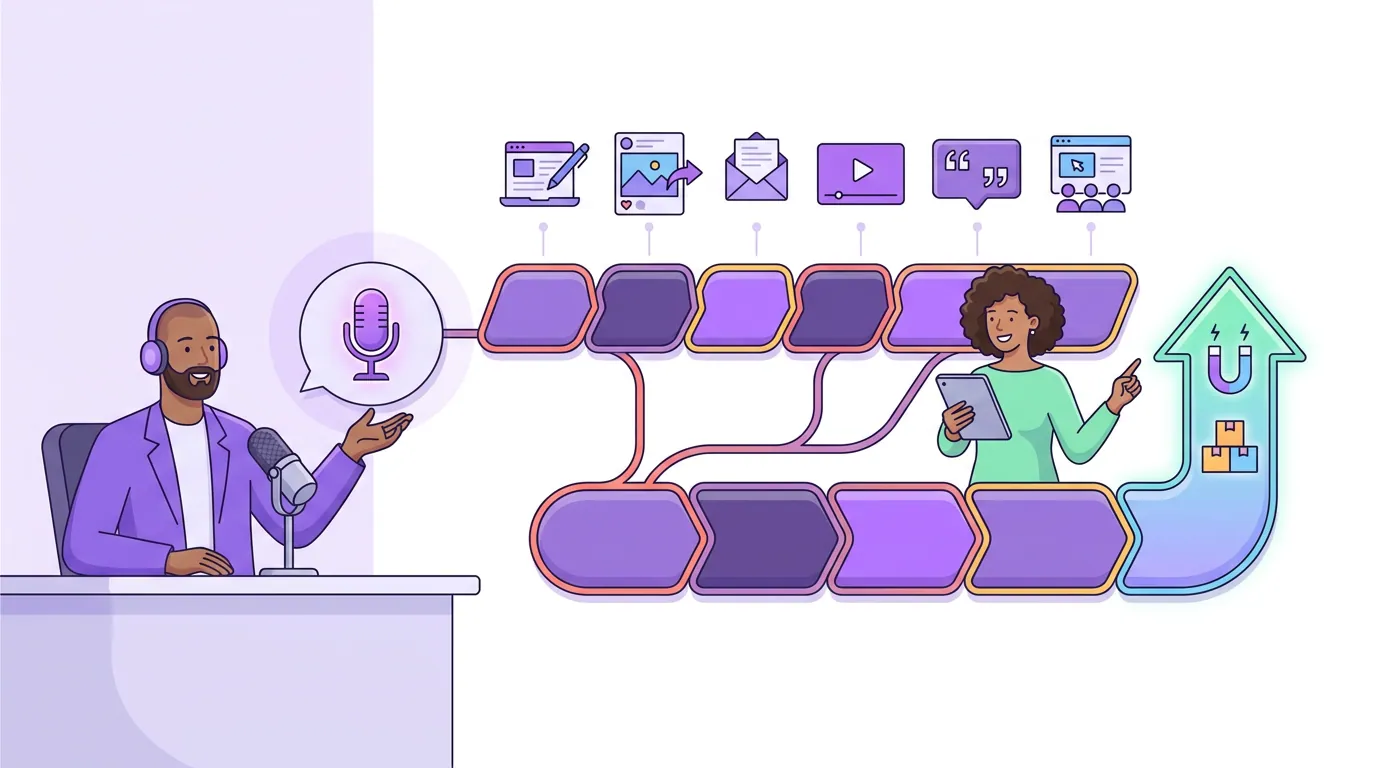
You stretch the interview across six weeks by treating the recording as raw material, not a single post. Clip the strongest 6 to 10 moments into vertical video, pull quote graphics, write a newsletter from the transcript, and time the guest's reshare for week two. One 45-minute conversation can carry a small show's calendar for over a month.
This is where guest strategy and clip strategy meet. The guest activates their audience once, on launch day, but clips keep the episode discoverable to new people long after. Posting clips consistently drives an estimated 20 to 40% of new audience for video shows and can lift reach 2 to 5x (Podcast Studio Glasgow), and because 53% of new US weekly listeners now prefer to watch rather than only listen (Backlinko), the clips are often where people first meet your show at all.
The week-six move is the one that turns guesting into a flywheel: re-tag the guest on the recap, then ask them to introduce you to the next guest on your list. A happy guest is your warmest referral into the next overlap network. That single ask, made after you have made them look good for six weeks, fills your pipeline better than any cold outreach.
Common mistakes that waste good guests
- Booking for fame, not willingness. A big name who never shares delivers their walk-in audience, which is almost nothing for a small show. Score willingness before you chase reach, and weight it heavily.
- Letting the episode die on launch day. One post, one share, done, and a 45-minute asset that took weeks to land is spent in 24 hours. Build the six-week plan before you record, so the clips and graphics are already scheduled.
- Making the guest's share hard. If you hand a guest a bare link and hope, most do nothing. Hand them two ready-to-post clips, a suggested caption, and a graphic with their face on it, and the share rate jumps. Do the work for them.
- Not capturing the audience you borrowed. Borrowed reach is rented; it leaves when the post scrolls past. Point every clip and episode at an email signup so the guest's audience becomes your audience, start with a podcast email list from zero and a welcome sequence that converts the first impression into a subscriber.
- Ignoring clippability when you book. A guest with a sharp, specific point of view gives you clips that travel; a guest who speaks in vague abstractions gives you nothing to cut. The same instinct that powers a comedy podcast's clippable moments applies in B2B, book people who say one thing memorably.
FAQ
How do you grow a business podcast with no audience? Borrow other people's. Book guests whose audience is your buyer and who will promote the episode, then turn each interview into weeks of clips. With no listeners of your own, the guest's reach is your entire distribution, which is exactly why guest selection, not posting frequency, is the first lever to pull.
Should I prioritize guest reach or audience overlap? Overlap, in most cases. A guest with 10,000 highly relevant followers usually delivers more qualified attention than one with 100,000 loosely related ones, because relevant impressions, reach times overlap, are what convert. Use the guest-ROI score to weigh both, but never let raw follower count outrank a tight audience match plus a real willingness to share.
How many clips should I make from one guest episode? As an editorial rule of thumb, 6 to 10 strong moments from a 45-minute interview is plenty to carry six weeks, not a fixed yield, since it depends on how clippable the guest is. Lead with the two sharpest for launch week, then release deeper cuts weekly so the episode keeps reaching new people long after the guest's own share fades.
Do B2B guests actually promote the episodes? The good ones do, because it serves them, appearing as an expert is professional currency. But willingness varies wildly, so confirm it before you book: ask directly whether they will share with their list and team. Make the share effortless by handing over ready clips and captions, and the rate climbs sharply.
Is guesting better than running ads to grow a podcast? For most B2B shows, yes, because guests deliver pre-qualified, vouched-for attention that ads cannot match on trust, and the cost is your time, not a budget. Ads buy cold impressions; a guest's endorsement borrows warm ones. The same audience-led logic shows up in niche playbooks like tying a fitness podcast's growth to program launches and growing a true crime podcast without crossing ethical lines.