
Where to End a True Crime Clip: the Cliffhanger Cut

End the clip on the question, never the answer. Cut the moment your host sets up the reveal, "and then forensics found something nobody expected", and stop before what they found. The brain cannot tolerate an open loop, so the viewer goes looking for the close. The only place to find it is your full episode.
This is the one rule that separates a clip that pulls people into the show from a clip that gives away the goods for free. Below is the decision rule in full, a three-beat template you can run on any episode, the exact line types to cut on, and the mistake almost everyone makes, clipping the resolution because it feels like the satisfying part.
Why ending on the answer kills a true crime clip
A true crime clip is a trailer, not a recap. Its job is to open a loop the viewer has to close somewhere else. When you cut on the reveal, the verdict, the confession, the cause of death, you close the loop inside the clip, and a closed loop has nowhere to send the viewer. They got the payoff for free, so they keep scrolling.
The genre rewards this more than most. True crime is consistently a top-five US podcast genre and one of the most over-served on social, which means a scroller has seen a hundred of these (Statista genre data). A clip that resolves is interchangeable with all of them. A clip that withholds is the one they screenshot and come back to.
There is real distribution upside in getting this right. Bite-sized podcast and interview moments now flood TikTok, Reels, and Shorts: the feed is more crowded, not less, so the open loop is what earns the save and the follow. For video shows specifically, one studio's client data puts clips at 20–40% of new audience and a 2–5× reach lift (Podcast Studio Glasgow); treat that as directional from a single production house, not a platform-wide audit. The mechanism is the same either way: a clip that makes you need the answer is a clip that converts a scroller into a listener.
The cut-point decision rule
Here is the rule in one line, plus the three-second test that tells you if you got it right.
Cut on the question, not the answer. If the last line of your clip resolves the tension, you cut too late. Back up to the line that promises the resolution and stop there.
The test: read your clip's final caption out loud, with the sound off. If your own reaction is "wait, what happened?", you cut in the right place. If your reaction is "huh, interesting," you cut on the answer and the loop is closed. Withholding feels slightly uncomfortable, like you're cheating the viewer. That discomfort is the signal you did it right.
This is the inverse of how you'd end a comedy clip, where you cut just after the punchline lands so the laugh has room, clipping comedy podcasts without killing the joke covers that timing. True crime runs the opposite logic: the payoff is the thing you deliberately keep off-screen.
The 3-beat suspense template
Every clip that holds attention to the end has the same shape underneath: a setup that frames the stakes, an escalation that raises them, and a withheld reveal you cut on. Find these three beats in the episode and you have your in-point and your out-point.
Beat 1, Setup (frame the stakes, fast). The first three to five seconds establish who and what is at risk: "She'd been missing for nine days when the call came in." No backstory dump. A muted scroller decides here, and most never turn the sound on, a widely cited figure puts as much as 85% of Facebook video viewed with the audio off (Digiday, 2016, publisher-reported and directional). Captions carry the setup; make the first line legible on its own.
Beat 2, Escalation (raise the tension). Something changes, sharpens, or contradicts the setup: "But the timeline didn't match what he told police." This is the middle of the clip and the part that earns the watch. One detail that reframes the stakes is enough; don't stack three.
Beat 3, Withheld reveal (promise, then cut). Your host or guest leans toward the answer, "and that's when the second body changed everything", and you cut on the promise of the reveal, not the reveal. The viewer now knows there is an answer and that you have it. They just don't have it yet.
The exact line types to cut on
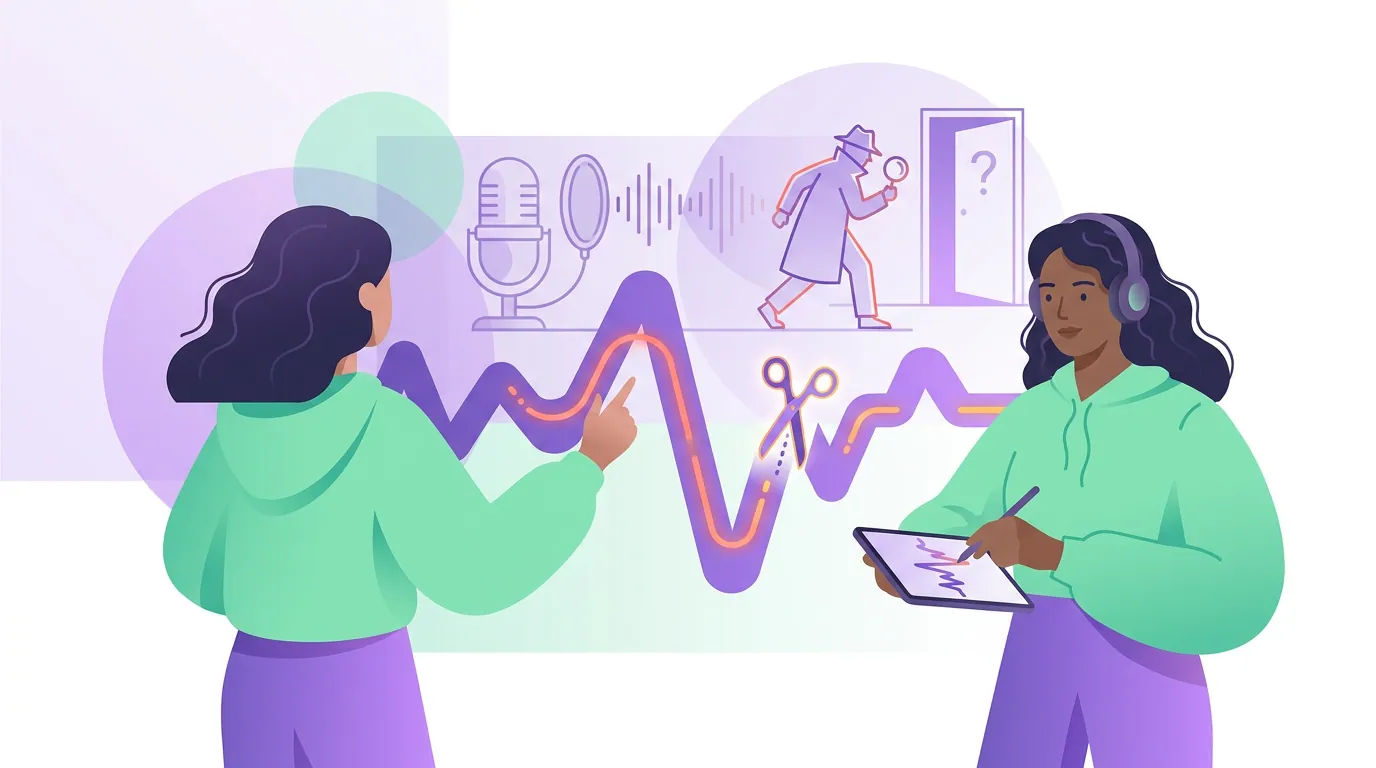
Not every line makes a good ending. The strongest cliffhanger cuts land on lines that explicitly point at an answer they don't give. Here is how the common line types rank as end points.
The top of that chart shares one trait: the line names that something happened without saying what. "And that changed everything." "Then the DNA came back." "What she said next stopped the interview cold." Each is a door the viewer has to walk through your episode to open.
Avoid ending on a clean fact ("The knife had his fingerprints on it") or, worst of all, the resolution itself. A fact is a closed statement; the verdict is the closed loop. Both end the clip for the viewer instead of handing the close to your episode.
How to do it in your editor, step by step
The edit itself is fast once you know what you're hunting for. This works whether you start from an AI-suggested clip or build it by hand.
- Read the transcript, not the waveform, for the out-point. Suspense lives in language, not audio energy. Scan the transcript for a line that promises a reveal, then mark that as your end candidate.
- Place the end handle on the breath right after the promise line. Leave a quarter-second of silence so it doesn't feel guillotined, then stop, before the next sentence delivers the answer. The same edge-trim mechanics apply as any other clip; fixing AI clips that start or end wrong covers the handle moves.
- Set the in-point at the setup line, not earlier. Cut the lead-in chatter. The clip should open on the stakes within the first three seconds.
- Run the muted-caption read. With sound off, read first caption to last. If the ending caption resolves the case, drag the end handle back one line. If it leaves you wanting, ship it.
- Pin the loop in the caption or a pinned comment. A line like "the full timeline is wilder, episode 47" gives the viewer the destination for the answer without spoiling it.
Common mistakes
Clipping the resolution because it's the satisfying part. The verdict feels like the climax, so editors reach for it. But the satisfying part is exactly what you must withhold. Cut the line before the satisfaction and let the episode deliver it.
Ending mid-sentence and calling it a cliffhanger. A chopped sentence ("...and then he, ") reads as a broken clip, not a tease. Cut on a complete line that promises a reveal, not a fragment that withholds randomly. The viewer should feel the loop open deliberately, not feel you ran out of clip.
Burying the setup behind ten seconds of intro. If the stakes don't land in the first three seconds, the muted scroller is gone before the tension starts. Trim the front hard. The setup line is your hook, not your host's "welcome back to the show."
Spoiling the answer in the caption. You held it in the clip, then typed the murderer's name in the description. Keep the caption pointing at the loop, not closing it. The whole edit is undone by one line of overshare.
Letting the AI's default cut keep the resolution. Detection models optimize for a complete, self-contained moment, which often means they include the answer because it makes the segment feel whole. That is the right instinct for most genres and the wrong one for suspense. How AI clip detection actually works explains why models bound segments around complete thoughts, and the rubric for picking the best AI-suggested clips shows how to override that default for true crime. For the moment-selection layer above the cut point, which true crime moments actually clip well is the companion piece.
FAQ
Where exactly should a true crime clip end? On the line that promises a reveal, one beat before the reveal itself. If the last caption resolves the case, names the killer, gives the verdict, states the cause, you cut too late. Back up to the setup line for the answer and stop there, leaving the loop open.
Isn't withholding the answer just clickbait? There's a line. Clickbait promises a payoff the episode doesn't deliver. A cliffhanger cut promises a real answer that genuinely lives in your episode. As long as the full show actually resolves what the clip teased, you're trailering, not baiting, and the listener who comes for the answer stays for the show.
How long should a true crime cliffhanger clip be? Long enough for all three beats and no longer, usually 20 to 45 seconds. Setup in the first three seconds, one escalation in the middle, the withheld reveal at the end. If you can't fit a clean three-beat arc, the moment is probably two clips, not one.
What if the best moment is the reveal itself? Then your cut point is the line right before it. The reveal being strong is exactly why you withhold it, that strength is what pulls the viewer into the episode. Use the lead-up as the clip and let the reveal be the reason they press play on the full show.
Should I tell viewers where to get the answer? Yes, but point at the destination without spoiling it. A caption or pinned comment like "full breakdown in episode 47" closes the navigation gap while keeping the loop open. Never put the answer in the caption, that undoes the entire edit.