
Solo, Co-Host, or Interview: Pick Your Core Format

Pick the format you can sustain weekly, not the one that sounds impressive. Solo is cheapest to run but hardest to perform; co-host splits the talking but ties your release schedule to one other person; interview brings built-in audiences and easy energy but makes you dependent on guests who cancel. Most beginners default to interview because it feels easy on camera, and then drown in booking. Choose on prep cost, scheduling burden, and guest dependency first.
Below is a head-to-head on all three across four axes that actually predict whether you keep publishing: prep cost, scheduling burden, guest dependency, and how each scales. Then a three-question decision rule, and the resource and personality profile each format fits. The goal is to talk you out of picking interview on autopilot, because the format that kills the most new shows is the one whose weekly workload you underestimated.
The four axes that decide it (not "which sounds best")
Format choice is usually framed as a taste question, chatty duo versus thoughtful monologue versus big-name guests. That framing skips the part that matters. The thing that determines whether a show reaches episode 20 is whether its weekly workload fits the host's actual time, money, and temperament.
Nearly half of all podcasts never get past their first three episodes, and most of the shows that quit do so between episodes 7 and 25, the stretch one source calls the "seven-episode wall" Amplifi Mediasummarizing podfade data). Notice the shape of that: shows don't die of bad audio, they die of stopping. And the cadence is unforgiving, the typical show publishes every 8–14 days (The Podcast Host industry stats), so a format you can only sustain in bursts quietly bleeds out between releases. So the right question is not "which format is best," but "which format can I keep shipping on that cadence without it collapsing." That makes scheduling burden and guest dependency more important than perceived quality.
Here is the scorecard the rest of this guide is built on.
The same comparison, as a table you can copy into your planning doc:
| Axis | Solo | Co-host / Interview |
|---|---|---|
| Prep cost per episode | High, you carry the whole script | Low for co-host (split the load); high for interview (research each guest) |
| Scheduling burden | Lowest, one calendar | Medium for co-host (two calendars); highest for interview (a new calendar every week) |
| Guest dependency | None | None for co-host; total for interview |
| Scaling limit | Your own output | Co-host availability; interview booking pipeline |
What each format actually costs you per week
Solo: cheapest to run, most expensive to perform
A solo show has the lightest logistics and the heaviest delivery. There is no one to schedule, no guest to chase, and no second mic to buy, gear-wise it is the simplest start, which is why a single budget mic is often all you need. The cost lands somewhere else: you write, structure, and carry the entire episode alone, and there is no co-host to rescue a flat moment or a lost train of thought.
That makes solo the highest-skill on-mic format despite being the lowest-logistics one. You need a real point of view and the discipline to prep, because a rambling monologue has nothing to hide behind. The upside is total control of your release schedule, solo shows podfade less from logistics and more from motivation. If your prep style is the bottleneck, decide early between scripting and outlining; solo hosts who wing it are the ones who burn out by episode eight.
Co-host: the load-sharer, capped by one calendar
A co-host format is the quiet workhorse, and it is underrated by beginners who assume "real" podcasts have guests. Two people split the prep, trade energy on the mic, and cover for each other when one is having an off day, which is exactly why co-hosted shows often feel the most natural to listen to. Prep cost per person drops, because you can each show up with half the material.
The catch is one extra calendar. Every recording now needs two humans free at the same time, and when your co-host travels, gets sick, or loses interest, your release schedule wobbles. Gear-wise you step up to a two-mic setup, but the real cost is interpersonal: a co-host who fades is harder to replace than a guest who cancels. Pick a co-host the way you would pick a business partner, because for your show's survival, that is what they are.
Interview: easy energy, hardest logistics, total guest dependency
Interview is the format beginners reach for first, and the one whose weekly cost they underestimate most. The on-mic part is genuinely easier, a good guest carries half the conversation, brings their own audience, and removes the pressure of being interesting alone. That borrowed reach is real, and it is why interview shows can grow faster early.
The hidden bill is the booking pipeline. Every single episode needs a different person to say yes, show up, and not reschedule, and the prep cost stays high, because you have to research each guest fresh. There is no batching your way out of it the way you can with solo or co-host. When a guest cancels the night before, you have a hole in your feed and no co-host to fill it. Interview is the format most exposed to the consistency problem that kills shows, which is the whole reason "pick interview by default" is a trap.
The decision rule: three questions, in order
You do not need to weigh all four axes in your head. Answer three yes-or-no questions, in this order, and the format falls out.
- Do you have a reliable co-host who will commit for at least 25 episodes? If yes, strongly consider co-host. It is the lowest-burnout format because the prep and the energy are shared, and it has no guest dependency. The "reliable" and "25 episodes" parts are the test, a flaky co-host is worse than no co-host.
- If not, can you book at least eight guests right now, today, without begging? Not "could I eventually", can you fill the next two months this week? If yes, interview is viable, because you have proven the pipeline exists. If you can only name two or three, interview will stall you by episode six.
- If neither, can you talk for 15–20 minutes on your topic with a point of view people would pay attention to? If yes, go solo and lean on a tight episode structure to carry the lack of a second voice. If no, the honest answer is to build the skill on a solo show first, or recruit a co-host before launching.
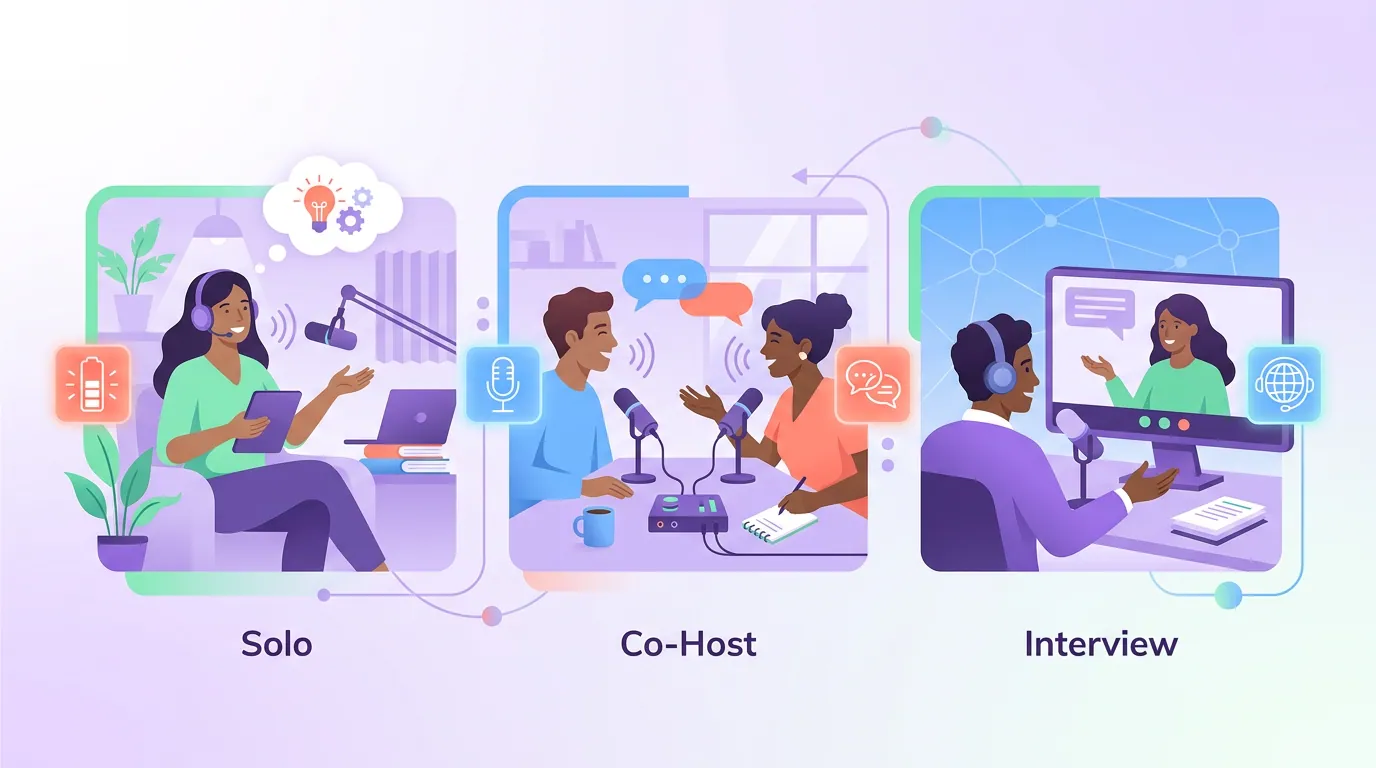
The resource and personality profile each format fits
The axes tell you the cost; this tells you the fit. Match the format to who you actually are, not who you wish you were on launch day.
- Solo fits the person with a clear point of view and a thin calendar. You have expertise or a strong take, limited time for coordination, and you would rather control your schedule than coordinate one. The trade you accept: you have to be interesting alone, and you have to prep. Solo rewards consistency more than charisma.
- Co-host fits the person who thinks out loud and has one trustworthy partner. You get sharper with a foil, you do not want to carry the energy alone, and you have someone whose reliability you would bet the show on. The trade: your release schedule is now a two-body problem.
- Interview fits the connector with a network and a research habit. You already know people worth hearing from, you enjoy preparing for a conversation, and you can run a booking pipeline like a small operation. The trade: you are never more than one cancellation from a gap, and the admin never stops.
A note many guides skip: these are core formats, not cages. The strongest small shows often run a hybrid, mostly co-host, with a guest every fourth episode, or mostly solo, with a monthly interview. Start with one core format so your workflow stabilizes, then add a second only once the first ships reliably. Genre nudges this too: comedy and culture lean co-host, expert and educational shows lean solo or interview, and the news-and-society category, among the largest by share (Statista top genres), spans all three.
Whatever you choose, format does not grow the show on its own, distribution does. Short clips drive an estimated 20–40% of new audience for video shows (Podcast Studio Glasgow), so whichever format you pick, plan to cut clips from day one rather than after episode 30.
Common mistakes when choosing a format
- Picking interview because it looks easy on camera. The on-mic part is easier; the weekly logistics are the hardest of the three. Beginners conflate the two and then stall when the booking pipeline dries up around episode six. Run the decision rule instead of defaulting.
- Choosing co-host without testing reliability. A co-host who fades mid-season is the most damaging failure of any format, because it is harder to replace a partner than a guest. Do two or three test recordings before you commit a name to the show.
- Going solo with no point of view. Solo punishes "I'll figure out what to say when I hit record." If you cannot fill 15 minutes with a take worth hearing, fix that on a few practice recordings before launch, or recruit a co-host.
- Switching formats every few episodes. Format-hopping resets your workflow each time and confuses the small audience you have. Commit to one core format for at least 10–15 episodes before judging it. Settle your episode length and structure first, since those interact with the format.
- Not planning for batching. Solo and co-host can be batch-recorded; interview rarely can, because each episode waits on a different person. If consistency is your weak spot, that alone is an argument against interview-only.
Frequently asked questions
What is the best podcast format for beginners?
For most beginners, co-host is the most forgiving, the prep and the on-mic energy are shared, and there is no guest dependency. If you have no reliable partner, go solo only if you can hold a 15–20 minute segment with a real point of view. Avoid interview-only at the start unless you can already book eight guests this week.
Is a solo podcast harder than an interview podcast?
On the mic, yes, solo is the highest-skill format because you carry the whole episode with no one to trade energy with. Logistically, it is the easiest: one calendar, no booking, fully batchable. Interview flips that: easier to perform, hardest to schedule and most dependent on other people showing up.
Can you switch podcast formats later?
Yes, but commit to one core format for at least 10–15 episodes first so your workflow stabilizes. The cleanest evolution is a hybrid, a mostly-solo or mostly-co-host show that adds an occasional guest, rather than swapping your primary format repeatedly, which resets your process and unsettles regular listeners.
Why shouldn't I just do an interview podcast?
Because the default ignores its real cost: every episode needs a new person to commit and show up, with high per-guest prep and no way to batch. That scheduling burden is what stalls new shows, nearly half never pass episode three Amplifi Media. Interview shines when your booking pipeline is real, and traps you when it is not.
Does the format affect how I should clip the episode?
Somewhat. Co-host and interview episodes give you natural back-and-forth moments and reactions that clip well, while solo shows clip best around a single strong statement or a tight teaching beat. All three work for short-form, just plan which moments you will cut before you record, regardless of format.
Pick one core format using the three-question rule, then lock the two things that shape your sound more than the format itself: your episode structure and your prep style, scripting or outlining. Record three episodes before you reconsider anything on this page.