
Batch-Record a Month of Podcast Episodes in One Day

Batch-recording means recording several episodes back-to-back in one session instead of one at a time across the week. Block a full day, prep every episode in advance so you never stop to think on mic, and record three to five in a row with short breaks. The payoff is a stocked queue that protects your publishing streak, the single biggest predictor of whether a show survives.
That last point is not motivational filler. Nearly half of all podcasts never make it past the first three episodes, and the most common cause is the per-episode grind catching up with the host before the show finds an audience Amplifi Mediaciting podfade data). Most that quit do so somewhere between episodes 7 and 25, the so-called seven-episode wall, and only about one in ten of all indexed shows are still active Amplifi Media. Batching is the cheapest insurance against quitting, because it decouples "did I publish this week" from "do I have time to record this week."
This is a full system, not a pep talk: the prep that must be done before you press record, a time-boxed studio-day schedule, how to keep your voice and audio consistent across back-to-back takes, and an honest number for how many episodes you can actually get done in a day.
Why batch-record instead of recording weekly?
Batching trades one hard day for three to five easy weeks. You pay the setup cost, mic placement, levels, mental warm-up, room reset, once instead of every single week, and you remove the recurring decision of "do I have a guest, a topic, and three free hours this Tuesday." Consistency stops depending on a good week.
The cost compounds in your favor. Setting up a rig, getting your gain staged, doing a vocal warm-up, and settling your nerves takes 20-40 minutes whether you record one episode or four. Spread across weekly sessions, that overhead is paid four times a month. In a batch, it's paid once. The minutes you save are real, but the bigger win is psychological: a recorded queue means a missed week is a non-event.
Batching also feeds your repurposing. One recording day produces a stack of source footage you can clip from for weeks, a 20-40 minute episode holds enough 30-90 second moments to feed a posting calendar (castmagic). Clips are not a side hustle here. They reportedly account for 20-40% of new audience acquisition for video shows, and posting them consistently can raise discovery reach 2x to 5x (Podcast Studio Glasgow). A queue of episodes is also a queue of clip material.
How many episodes can you actually record in one day?
Plan for three to four finished episodes if you host alone, and two to three if you run interviews where guest scheduling and small talk eat time. Past four, quality usually slips, your voice tires, your pacing flattens, and you start repeating phrasings between episodes. The fifth take is rarely your best work.
That range assumes a roughly 30-40 minute show. If your episodes run longer, fewer fit; the case for the right episode length for your format gets stronger when you're recording in bulk, because shorter, tighter episodes batch more cleanly. Solo formats batch the fastest because there's no second calendar to coordinate. The trade-offs between solo, co-host, and interview formats show up clearly on a batch day, interviews are the hardest to stack because each guest is a separate booking.
Don't optimize for a record-breaking count. The goal is a clean, consistent queue, not a personal best. Three episodes you'd happily publish beat five you'll dread editing.
The pre-record prep that makes batching possible
Batching only works if you do zero thinking on mic. Every decision, topic, structure, key points, transitions, happens before the studio day. The recording session is execution, not creation. This is the part most "batch your podcast" advice skips, and it's the part that determines whether your day produces three episodes or three half-starts.
- Outline or script every episode in advance. Each one needs its own one-page plan: hook, three to five beats, and the close. Whether you write full scripts or bullet outlines depends on your delivery style, the case for scripting versus outlining is real, and batching rewards whichever one lets you talk without stalling. Pick one and prep all episodes the same way.
- Reuse a fixed episode skeleton. A repeatable episode structure, cold open, intro, segments, call to action, means you're not reinventing the shape of each show on the fly. Same skeleton, different content. This is what lets you move from episode one to episode two without a mental reset.
- Pre-write your intros and outros, or record them once. If your intro and outro are scripted and identical across the batch, record them in a single pass and drop them in during editing. That's three to four fewer cold starts.
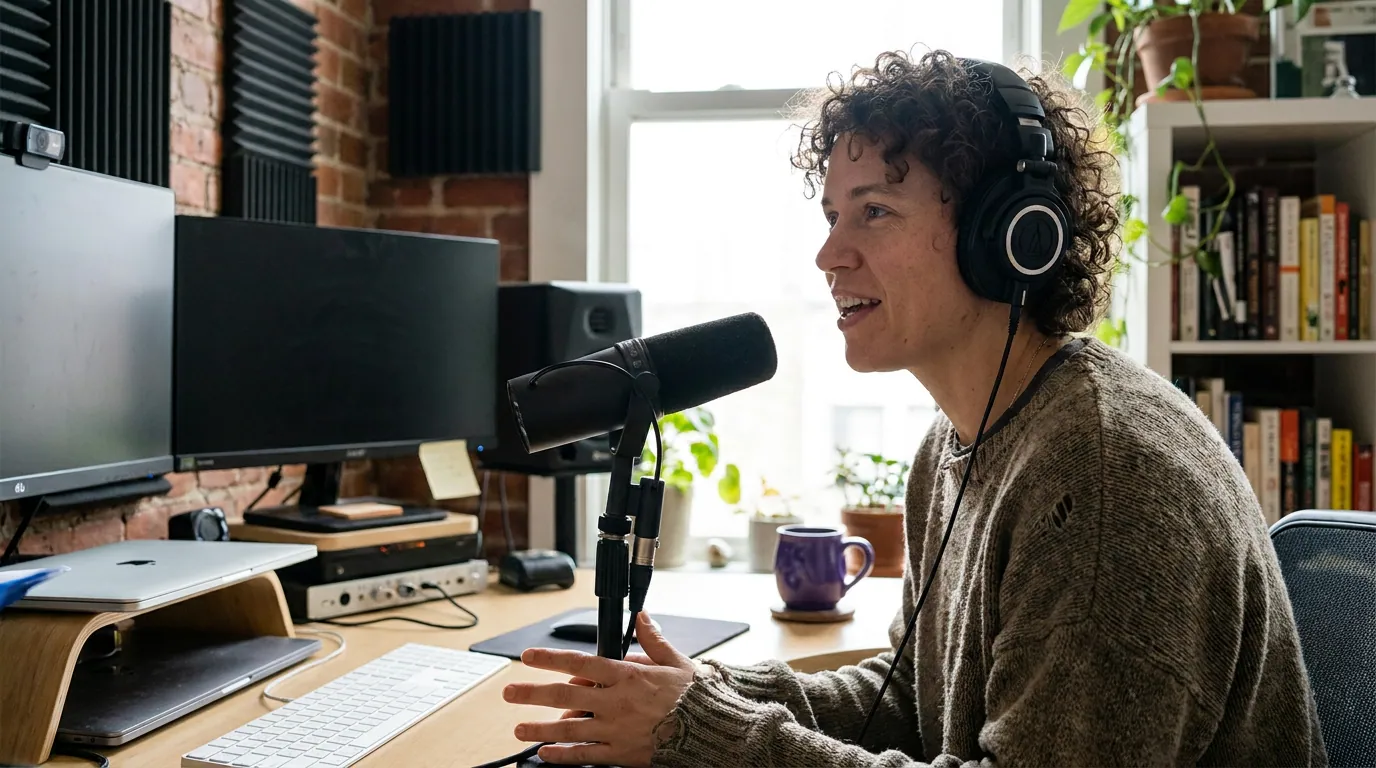
- Stage your gear before you sit down. Set mic position, gain, and headphone monitoring once, then don't touch them. Mark your mic distance with tape if you have to. The mic that fits your room and budget matters less than keeping it in the exact same position for every episode, consistency across takes is what makes the batch sound like one show.
- Do a real recorded test. Record 30 seconds, listen back on headphones, check levels and room noise, then commit. Catching a problem in the test is free; catching it after episode three is a re-record.
- Lay out your assets. Guest names, links, ad reads, sponsor copy, stats you want to cite, all open on a second screen or printed. Hunting for a figure mid-record breaks your flow and your take.
If you can't outline an episode before the studio day, it's not ready to batch. Cut it from the day's list rather than improvising on mic.

How to keep energy and audio consistent across back-to-back episodes
Your voice and your enthusiasm both degrade across a long session, that's biology, not a failure of will. The fix is to schedule the dip instead of fighting it: front-load your hardest episode, take short breaks between takes, and standardize everything physical so the audio never changes even when you do.
Keep the audio identical:
- Lock the physical setup. Same seat, same mic distance, same gain, same headphones. Don't adjust between episodes, variation in mic distance is the most common reason batched episodes sound mismatched. Solid technique in a fixed position matters more than the gear itself; a budget mic under $100 kept in one spot beats an expensive mic you keep nudging.
- Have water at room temperature within reach. Cold drinks tighten your voice; sip between episodes, not during takes.
- Keep the room conditions stable, same windows, same fan setting, same time-of-day light if you're filming. Don't open a window for episode three.
- Record a five-second silence sample at the start. It gives your editor (or your noise-reduction tool) a clean noise profile to work from.
Keep the energy up:
- Record your most demanding episode first, while you're fresh. Save lighter or more familiar topics for the back half.
- Take a real break every one to two episodes. Stand up, stretch, walk, hydrate. Five to ten minutes resets your voice; the long mid-session break resets your focus.
- Do a 60-second vocal and energy reset before each take. Roll your shoulders, do a couple of tongue twisters, smile before you hit record. A flat opening is the most fixable problem on this list and the one batchers most often ignore by episode three.
- Change one small thing between episodes so they don't blur together, a different shirt if you're filming, a slightly different seated posture, a fresh sip of water. It keeps each episode feeling distinct to you and to the listener.
- Watch your filler. Tiredness multiplies "um," "like," and trailing sentences. If you hear yourself drifting, that's the signal to take the break, not to push through.
Common batch-recording mistakes (and the fix)
- Recording without finished outlines. The single most common failure. You sit down to record four episodes, stall on episode two, and lose the day. Fix: nothing goes on the studio-day list until its one-page plan is written.
- Touching the gain or mic between takes. Mismatched levels across a batch are a headache to fix in edit. Fix: stage once, mark your mic distance, and don't adjust.
- Skipping breaks to "stay in the zone." Pushing through is how episodes three and four come out flat and rushed. Fix: breaks are part of the schedule, not a reward.
- Targeting too many episodes. Five mediocre takes are worse than three good ones. Fix: cap your target at four for solo, three for interviews, and treat the last as optional.
- No buffer for re-records. A stumble on episode two with no time to redo it means publishing something you're not happy with. Fix: build a 30-minute buffer into the day.
- Letting the queue go stale. Batch a topic that dates quickly and it's useless by the time it publishes. Fix: batch evergreen episodes; keep timely ones for single sessions.
FAQ
How far ahead should I batch episodes? Two to four weeks is the sweet spot for most weekly shows, enough buffer to absorb a bad week without recording content that goes stale before it airs. Batch a month at a time if your topics are evergreen. For news-driven or timely shows, keep the buffer short and record those episodes individually.
Does batching hurt episode quality? It can, if you over-stack the day. The first three episodes are usually as good as single-session work; quality reliably drops on the fourth and fifth as your voice tires. Cap your count, take real breaks, and record your hardest episode first to keep quality flat where it counts.
Can I batch interview episodes? Partly. You can't easily stack different guests in one sitting, but you can batch all of your own prep, intros, outros, and solo segments in one block and schedule guest recordings separately. Batch the parts you control; keep guest sessions on their own calendar.
What if I make a mistake mid-batch? Keep rolling and clap or pause clearly so the spot is easy to find in editing, then continue, don't restart the whole episode. Build a 30-minute buffer into your day for the one episode that genuinely needs a redo.
Do I need special gear to batch-record? No. Batching is a scheduling and prep discipline, not an equipment upgrade. Any setup that records one good episode records four, what matters is keeping that setup untouched across the session so every episode sounds the same.