
Making Podcast Clips: With AI vs. By Hand


Use AI to find and rough-cut your clips, then finish the ones that matter by hand. AI wins decisively on time and breaks even on quality for ordinary spoken-word moments; hand-clipping wins on control and on the handful of moments that depend on a face, a visual, or context the model can't read. The honest answer is not "either", it's AI first, human last, with a clear rule for where the human steps in.
That rule is the point of this page. Most "AI vs. manual" comparisons end at "AI is faster, but humans are better," which is true and useless. What you actually need is a way to decide, clip by clip, which side to put the work on, and that decision turns out to depend almost entirely on the type of moment, not on the tool's marketing. Below is the head-to-head on the three things that matter, then the moment-type rule.
Why the choice matters now
Clips are how shows get found. 57% of listeners now name social media as their top source for podcast recommendations, the first time it has edged past friends and family (54%), per a 2025 Coleman Insights/Amplifi survey of 1,000 U.S. consumers (Inside Radio), and short clips can account for 20–40% of new audience for video shows (Podcast Studio Glasgow, citing NEWMEDIA.COM), a vendor estimate, not a platform-wide audit, but the direction is consistent. And the clip economy is now big enough to dwarf the source: NPR profiled a streamer whose livestreams average ~33,000 views while his clips average more than 700,000.
So the real question isn't whether to clip. It's how to clip enough, consistently, without it eating your week, and that is exactly the tradeoff AI changes. Hand-clipping a whole episode well is a craft and a time sink. AI removes most of the time, keeps most of the quality, and hands the judgment calls back to you. Knowing which calls are yours is the whole skill.
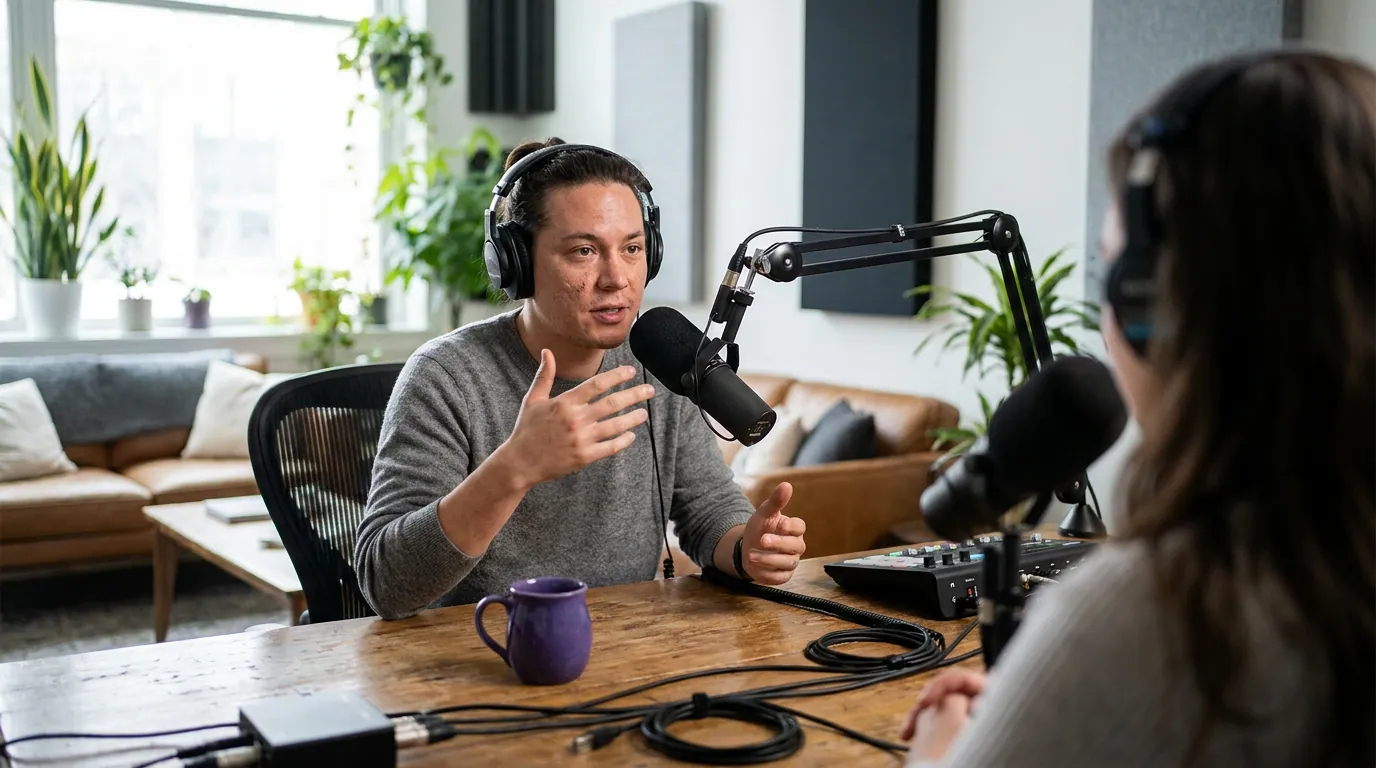
AI vs. by hand: the head-to-head
Score the two approaches on the three axes that decide whether you keep clipping past month two: time, control, and quality. Neither wins all three.
Time. This is not close. Editing a single clip by hand, finding the moment, trimming the in and out, reframing to vertical, captioning, fixing caption errors, exporting, runs roughly 30 to 60 minutes once you include the picking and the review. An AI pass turns a full episode into a batch of captioned, vertical, ready-to-review clips in minutes. For a weekly show, that's the difference between an afternoon and a coffee break.
Control. Hand-clipping wins, by definition. You decide every frame: the exact word the clip opens on, where the cut lands relative to a breath, which beat of a laugh to end on. AI gives you a strong draft and editable handles, but the first pass is the model's read of the moment, not yours. You're correcting toward your taste rather than building from it.
Quality. This is the surprise. For ordinary spoken-word moments, a clean answer, a strong opinion, a tight story, a reviewed AI clip and a hand-cut clip are hard to tell apart, because the moment is carried by the words and AI reads words well. The gap opens only on moments where the value isn't in the transcript. That's the seam the decision rule below is built around.
Where the hours actually go
The time story is more lopsided than "AI is faster" suggests, because the savings compound across an episode. Hand-clipping ten clips is ten separate 30-to-60-minute jobs. AI-first clipping is one batch pass plus a review queue, and the review is fast precisely because you only stop on the clips that need you.
The caveat that keeps this honest: every AI clipper still needs roughly 20–40% human review. A reframe that crops a face, a caption that mishears a name, a cut that lands mid-word, these happen, and an unreviewed batch will ship a few duds. AI buys you the time; it doesn't buy you the right to skip looking. The review queue is the work that stays human no matter how good the model gets.

The decision rule: which moments to trust AI on
Here is the part the generic comparisons skip. The right tool depends on the moment, not the show. Sort every candidate moment into one of these buckets and the choice makes itself.
Trust AI on the words-carried moments. A clean quote, a clear question and answer, a self-contained story, a crisp explainer, a standalone hot take, these live in the transcript, and the transcript is exactly what AI reads. As covered in how AI clip detection actually works, the model scores topic shifts, sentiment, energy, and sentence boundaries. For words-carried moments those signals are enough. Let it cut, glance at the result, ship.
Clip by hand on the four exceptions. Each one fails for a specific reason the model can't fix:
- The value is on screen, not in the words. A reaction, a whiteboard sketch, a product held up to camera, a gesture that lands the joke. The transcript looks ordinary; the moment isn't. AI down-ranks it because nothing in the text stands out. You saw it live, clip it yourself.
- Comedic or punchline timing. A laugh lives in the half-second before and after the line. AI cuts on sentence boundaries, which is usually a beat early or a beat late for comedy. The fix is two or three frames of trim that only a human ear catches.
- Sensitive or easily-misread lines. Anything where a tight cut changes the meaning, strips a "but," or makes a careful point sound careless. The model optimizes for what travels, not for whether you'd want it amplified. This one is reputational, so it's always yours.
- Your signature clip of the week. The one clip you're betting on, the hook you'll test, the moment you want pinned. AI gets you a strong draft; the last 10% of polish on your best clip is worth doing by hand, every time.
For the broader method of separating the clips worth your time from the filler, see how to pick the best AI-suggested clips. The decision rule above is the fast version: sort, trust the left column, spend your hand-editing minutes only on the right.
The workflow that uses both
The strongest setup isn't AI or manual. It's a pipeline that runs AI first and reserves your time for the right column of the rule.
- Batch the whole episode with AI. Get every candidate clip cut, reframed, and captioned in one pass. Don't pre-filter, let it surface moments you'd have skipped.
- Triage in one sitting. Sort the batch into ship-now, quick-fix, and clip-by-hand. The ship-now pile is your volume; it's usually the majority.
- Fix the quick ones. A caption typo, a name the model misheard, a reframe that needs nudging. Minutes each.
- Hand-finish the exceptions. The visual moments, the timing-dependent ones, the sensitive lines, and your bet of the week. This is where your editing taste earns its keep.
- Schedule and post native. Export at 1080×1920 and post directly to each platform rather than reposting a downloaded file.
This is the same answer whether your source is a YouTube podcast video, an audio-only episode, a Zoom recording, or a Riverside session, AI handles the source-format conversion and the bulk cut; you handle the moments that need a human.
Common mistakes
Treating AI as all-or-nothing. The trap is "I tried AI and it missed my best clip, so I went back to doing it all by hand." Wrong lesson. It missed one type of moment. Use it for the other four and clip that one by hand.
Shipping the batch unreviewed. The flip side. AI saves the time it saves because you skip review, but the 20–40% that needs a fix will embarrass you if you don't look. Speed is the batch pass; quality is the triage.
Hand-clipping the easy ones. Spending 40 minutes hand-cutting a clean quote AI would've nailed is the most common time leak. Save your hours for the right column.
Letting the model pick your bet. AI is a strong scout, not a closer. The one clip you're staking the week on deserves your hands on it, not autopilot.
Cutting comedy on sentence boundaries. AI's default cut points kill timing. If the clip is a joke, trim it by ear.
FAQ
Is AI or manual clipping better for podcasts? Neither alone, use both. AI is far faster and matches manual quality on words-carried moments (quotes, Q&A, stories, explainers), so let it batch the episode and ship those after a glance. Clip by hand only the moments that depend on a visual, on comedic timing, on sensitive context, or that are your signature bet of the week.
How much faster is AI clipping than doing it by hand? Substantially. Hand-clipping runs roughly 30–60 minutes per clip once you include picking, trimming, reframing, captioning, and review. An AI pass turns a full episode into a batch of reviewable clips in minutes, then you spend about an hour reviewing, versus six to ten hours hand-cutting ten clips. The savings come from doing the picking and captioning in one batch.
Does AI clipping produce lower-quality clips? Not on ordinary spoken moments, where a reviewed AI clip is hard to distinguish from a hand-cut one because the words carry it. Quality only drops on moments the transcript can't capture, visual payoffs, comedic timing, context-sensitive lines. That's why the rule sends those to a human and trusts AI on the rest.
Do I still need to edit AI-generated clips? Yes. Roughly 20–40% of AI clips need a human touch, a caption fix, a reframe nudge, a cut adjustment. Treat AI as an accelerant that does the bulk cut and captioning, not a replacement editor. The review queue is fast because you only stop on the clips that need you.
Should a beginner start with AI or learn to clip manually first? Start with AI. It gets you posting clips this week instead of next month, and reviewing its cuts teaches you what a good clip looks like faster than starting from a blank timeline. Once you can spot the four moment types that need a human, you'll know exactly when to clip by hand.