
Fitness Podcast Clips: Talk vs Demonstration

A fitness clip needs visual demonstration only when the point fails without seeing the movement, a form cue, an exercise variation, a "here's the difference between these two reps." Everything else, which is most of a coaching episode, works as talking-head with strong captions: programming logic, recovery, nutrition, mindset, motivation. The rule is simple and most coaches get it backwards: they shoot b-roll for the advice and skip it for the form.
Below is the decision matrix I use to route every fitness clip to one of three treatments. It turns "should I film a demo?" from a gut call into a two-question check you can make in ten seconds per clip.
The one question that decides everything
Before you reach for b-roll, ask: if a stranger heard this line with their eyes closed, would they still get it? If yes, the clip is verbal, the value is in the sentence, and your face plus accurate captions deliver it. If no, if the line points at a movement, a position, a "watch what my hips do here", then the claim is visual and the demo is the clip, not decoration.
This matters because clips are where a fitness show actually grows. One production studio attributes 20–40% of new audience and a 2–5× reach lift to clips (Podcast Studio Glasgow), treat that as a directional range from one production house, not a platform-wide audit. Either way, if clips carry that much of your growth, spending demo time on the wrong clips is spending it on growth you do not get.
There is a crowding reason to be deliberate too. Short-form clips of long-form content now flood every feed, with freelance clippers churning out bite-sized podcast and video moments by the thousand. A fitness feed in particular is wall-to-wall demos. A talking-head clip that says something specific often stands out more than the thousandth squat tutorial, so do not assume video of the movement is always the stronger play.
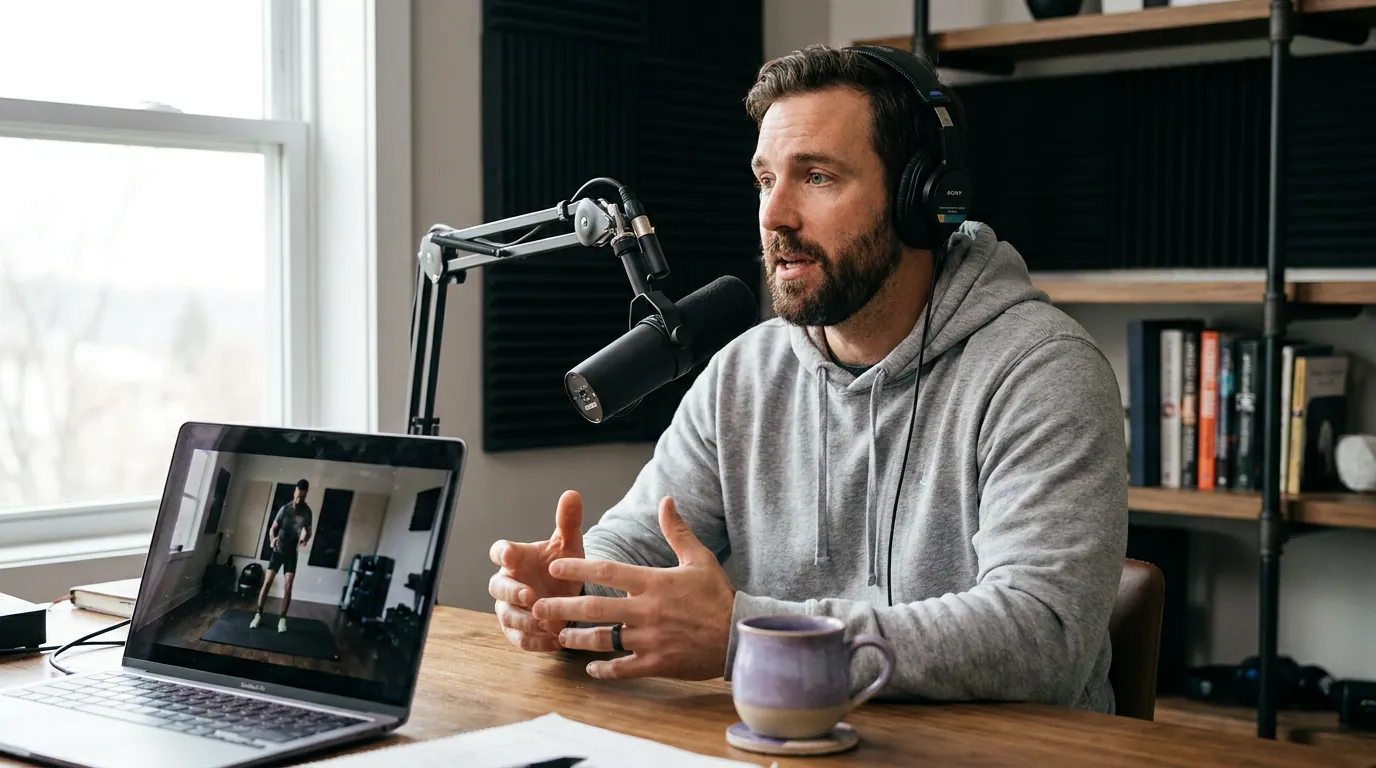
The three treatments, and what each is for
Every fitness clip falls into one of three buckets. Knowing which one a clip is before you start editing saves you from over-producing the cheap clips and under-producing the ones that need it.
1. Talking-head. Your face, your mic, accurate captions. This is the default and it carries the majority of a coaching episode, the "why" behind a method, a take on a popular trend, a coaching philosophy, a story about a client. The value is the sentence. Filming a demo over it just hides your face, which on a personal-brand fitness account is the thing people follow.
2. Demonstration (talking-head + b-roll). You explain, then the clip cuts to footage of the actual movement at the moment the words point to it. Use this when the line names a position or motion the viewer cannot picture from words alone: "let your knees track over your toes, not collapse in," "the bar path should be straight, like this." The b-roll is not garnish, it is the proof of the claim.
3. Text-on-screen. Large captions are the visual; the face is optional. Use this for list-style content (a 3-step warmup, four signs you are under-recovering) and for audio-only takes where you have no usable video. It is the right call when a still or simple background plus bold, well-timed text reads cleaner than a face would.
The mistake I see constantly: coaches film an elaborate demo for a clip about motivation (verbal, your face is the asset), then post a form correction as talking-head where you can't see the movement they're correcting (visual, the demo was the whole point). Match the treatment to the claim, not to whichever one feels more produced.
How AI clipping fits each treatment
AI clip detection reads the same signals on a fitness episode it reads anywhere, topic shifts, question-answer pairs, sentiment, energy, and pauses. If you want the mechanics, how AI clip detection actually works breaks down each one. What matters for fitness is that the model finds the moment well but knows nothing about whether that moment needs a demo. That call is yours.
So the workflow is: let the AI surface the candidates, then run each through the routing question above. The model will hand you a 30-second stretch where you say "and that's the cue that fixes most people's deadlift", it cannot tell you to cut in footage of the deadlift right there. You can. Treat the AI output as a shortlist to triage, not a finished post; the rubric in how to pick the best AI-suggested clips applies cleanly here.
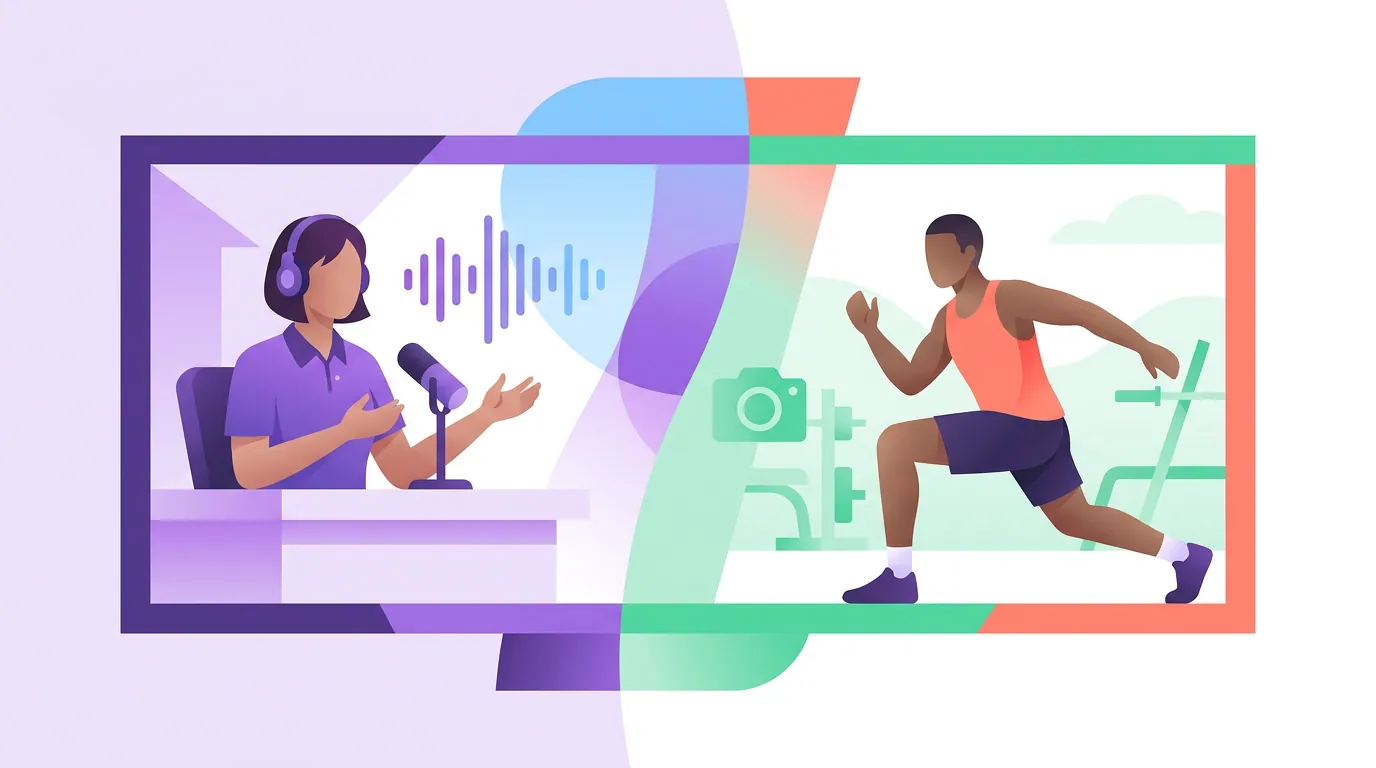
The b-roll-vs-talking-head rule for coaches
Here is the part specific to fitness, because the b-roll tradeoff hits coaches differently than it hits a business or true-crime show.
Your face is an asset, not filler. Fitness is a trust-and-results business. People follow a coach, not a tutorial channel. Covering your talking-head with stock gym footage to "make it more visual" usually weakens a clip that was working, it removes the human the viewer is deciding whether to trust. Keep your face on screen unless the demo is the point.
Demo b-roll has to be tight and on-cue. When you do cut to the movement, it should appear exactly when the words reach it and stay only as long as the cue runs, usually three to six seconds. A loose 15-second demo over a 10-second point pads the clip and drops retention. Shoot a short, clean demo on a phone (the photo brief below) and trim it to the cue.
Captions are non-negotiable in every treatment. Most social video is watched on mute, publishers told Digiday roughly 85% of Facebook video is viewed without sound (Digiday, 2016, publisher-reported, so treat as directional and dated, not a current platform stat). A muted form clip with no captions is a person silently moving, useless. The captions carry the cue; the video shows it. They work as a pair.
When in doubt, default to talking-head. It is faster to make, it keeps your face on screen, and the data says a specific spoken line often beats another demo in a feed already drowning in them. Reserve the demo effort for the clips that genuinely fail without it.
Common mistakes coaches make
Filming a demo for verbal advice. A clip about consistency or a diet myth does not improve with gym b-roll over your face, it loses the trust signal. Check the routing question first: if it survives with eyes closed, leave your face on.
Posting a form clip with the audio on as the test. You know the cue, so it reads complete to you. Mute your own playback and watch: if the captions plus the demo don't teach the cue on their own, the clip isn't done. This is the same mute-test discipline that catches cut-off lines in any genre, see how it plays out for narrative shows in where to end a clip for max suspense.
Letting demo b-roll run long. Three to six seconds, on the cue, then back to you. A demo that overstays kills retention faster than no demo at all.
Treating every list as text-on-screen. A list with emotional weight, "four signs you're overtraining and need to stop", often plays better as talking-head, because the urgency is in how you say it. Reserve pure text-on-screen for low-charge, scannable content.
Ignoring how the line is delivered. Fitness clips live on conviction. A flat read of a great cue underperforms a sharp read of an average one, the same delivery lesson that makes or breaks a business podcast clip and decides whether a comedy clip lands its punchline.
FAQ
Do fitness podcast clips need to show the exercise? Only when the point fails without seeing it, a form cue, a movement comparison, an unusual variation. Most coaching content (programming logic, nutrition, recovery, mindset) is verbal and works as talking-head with strong captions. Ask whether a listener with their eyes closed would still get the point; if yes, skip the demo.
Is talking-head or demonstration better for a fitness Reel? Neither is universally better, they serve different claims. Talking-head keeps your face on screen, which matters for a trust-based coaching brand, and it stands out in a feed saturated with demos. Demonstration wins when the value is the movement itself. Route each clip by the claim, not by which looks more produced.
How long should the demo b-roll be in a clip? Three to six seconds, cut in exactly when the words reach the movement and out as soon as the cue runs. Loose, long demos pad the clip and drop retention. Shoot a short, clean demo on a phone and trim it to the spoken cue rather than running the whole set.
Can I make fitness clips without filming any demos? Yes. Talking-head and text-on-screen together cover roughly three-quarters of a typical coaching episode in our clip-review patterns. Film demos only for the minority of clips whose point depends on the movement. A face and accurate captions carry the rest.
Why do my fitness clips flop with the sound off? Because the captions aren't carrying the point. With a large share of social video watched on mute (Digiday, 2016, directional), a clip has to read with no audio, the captions deliver the cue and the video shows it. Add accurate, well-timed captions to every treatment, demo or not.