
How to Find the Best Moments to Clip in a Podcast


Find the best moments to clip by scoring each candidate on five axes, tension, surprise, contrarian take, vulnerable story, and quotable line, and shipping only the highest scores. Give each axis 0, 1, or 2 points. Anything that totals 7 or more out of 10 is worth editing; 5–6 needs a fix; below 5 stays in the episode.
The trick is to stop asking "is this good," because you can't scan a 40-minute episode for "good." You can score five specific things. A number forces a decision, ranks candidates against each other, and gives you something to compare next week when you want to learn what actually traveled. This guide is the rubric, a worked example, and the mistakes that wreck it.
Why a score beats a gut call
A score does three jobs a gut call can't. It makes you compare candidates against each other instead of judging each one in isolation, which is where you waste a whole afternoon editing a moment that felt great in the room and dies cold. It catches the moment your gut skips, the quiet, costly admission that scores high on vulnerability but didn't grab you live. And it builds a record: next month you can look back and see that your 8s outperformed your 6s, which is how you learn your show instead of guessing.
The stakes are not small. For a video show, clips can drive an estimated 20–40% of new audience and raise discovery reach 2–5x (Podcast Studio Glasgow, a single studio's client data, so directional, not a platform-audited law), and the feed those clips land in is more crowded every year as a paid "clipping economy" floods it with cut-downs. With that much supply, a clip earns attention on the strength of the moment, not the fact that you posted it. Picking the right moment is most of the job, and a rubric is how you pick the same way twice.
The five-axis moment score
Each candidate moment gets scored 0, 1, or 2 on five axes. Two means strongly present, one means somewhat, zero means absent. Add them up for a total out of 10.
Tension (0–2). Is there a stake, a conflict, or an open question that pulls a stranger forward? Two is a real clash or a cliffhanger setup. One is mild stakes. Zero is pleasant agreement with nothing pulling. Tension is the single most reliable predictor of completion, because an unresolved question is the only thing that holds a thumb still.
Surprise (0–2). Does something break the listener's expectation, a number, a reversal, a fact they'd bet against? Two is a genuine "wait, what" moment. Concrete figures score here: "I spent fourteen years and $400,000 before this worked" is a 2; "it took a while and cost a lot" is a 0.
Contrarian take (0–2). Does the speaker name the conventional wisdom and break it? Two is a clean "everyone says X, they're wrong, here's why." Disagreement with consensus is an instant hook, the viewer either nods hard or argues in the comments, and both keep the clip alive.
Vulnerable story (0–2). Is there an honest, slightly costly admission, a failure, a fear, a thing rarely said aloud? Two is a real confession with a visible cost. These travel because they're rare; most public talk is polished. This is the axis your gut most often under-scores live, which is exactly why scoring it on a second listen pays.
Quotable line (0–2). Is there one sentence sharp enough to put on screen as text, screenshot, or repeat word for word? Two is a line you could caption verbatim and it would carry the clip. A clip can score low on the other four and still travel on a single perfect line.
The five overlap on purpose. A great moment usually fires on three or four of them at once, that stacking is what a high total captures and a single-type label misses.
A worked example: three candidates, three calls
Say you pulled three candidates from one episode. Here's how scoring resolves them.
Candidate A scored a 9, a contrarian claim with a surprising number and a quotable line, only light on the personal story. Obvious ship. Candidate B scored a 5: a genuinely useful tip with a strong line, but no tension and a slow open. That's the "fix" zone, the tip is real, but it buries its hook, so you re-cut it to open on the line. Candidate C scored a 2: pleasant, agreeable, no stakes. It was a nice episode beat and a dead clip. Drop it without guilt. Without the rubric, B and C feel similar in the moment. The numbers separate them in five seconds.
The decision rule
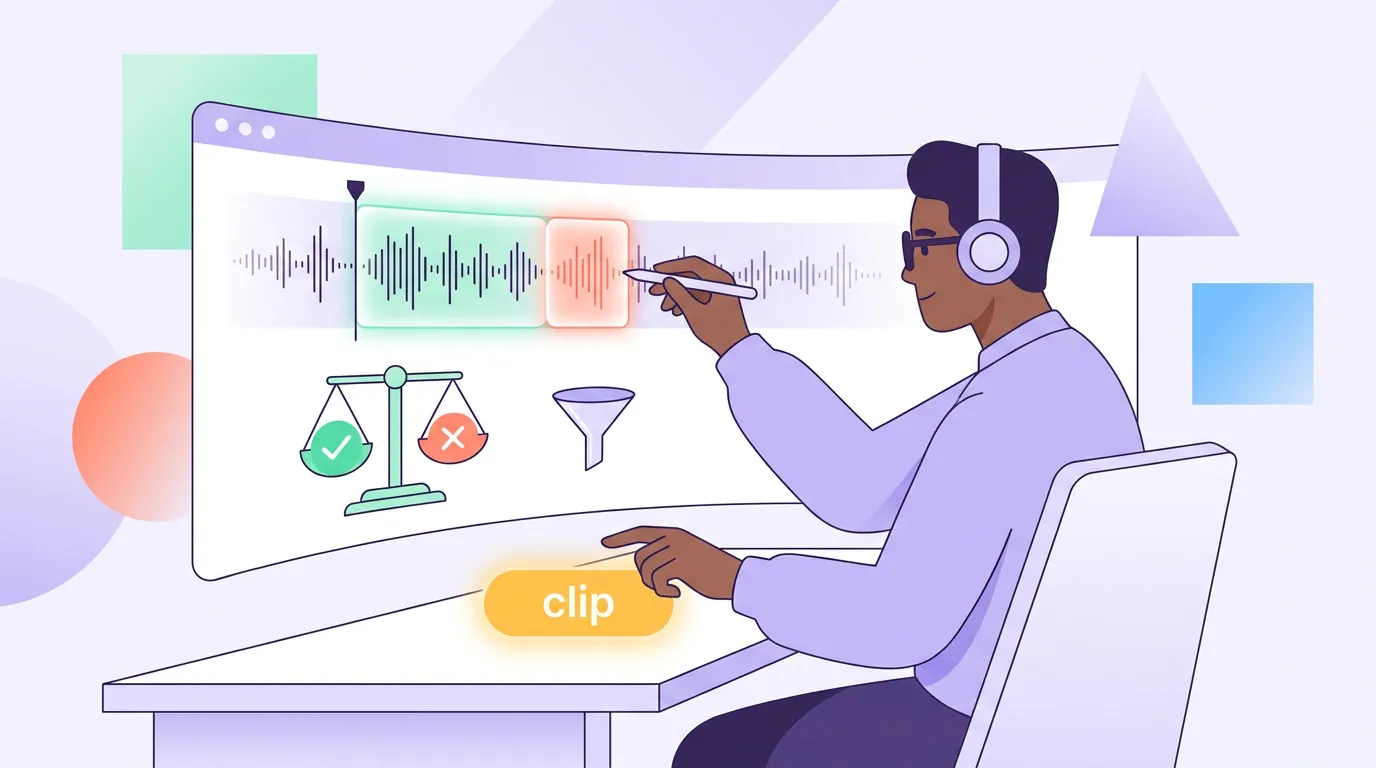
- Listen back once at 1.25x with a timestamp in hand. Speeding up keeps you alert and cuts the pass to about four-fifths of the runtime. Don't open an editor yet, your only job is to spot candidates and score them.
- Score each candidate on the five axes. Write one line per moment:
timestamp, T/S/C/V/Q scores, total, note. For example:14:20, 2/2/2/1/2, 9, "$400k over 14 years". Don't rewind mid-pass; if you're unsure on an axis, give it a 1 and move on. - Sort by total and apply the rule. Edit your 7-plus scores first, in order. Pull any 5–6 into a "fix" pile. Discard everything under 5.
- Fix the 5s and 6s by re-cutting the open. Most mid-scoring moments fail on tension because the good part is buried, and the opening three seconds decide whether anyone stays (castmagic). Trim so the clip opens on the line or the claim, then re-score. If it still doesn't clear 7, drop it.
- Stop at your weekly target, not at exhaustion. Decide up front how many clips you need this week and cut the list to that. A single episode usually surfaces far more candidates than you'll ship, AI clip detection typically narrows hundreds of overlapping windows to a shortlist, and your job is to ship only the few that score.
Common mistakes that wreck the score
- Scoring "importance" instead of the five axes. The most meaningful exchange in the episode often needs the most setup, which tanks its tension score as a standalone clip. Score what a stranger experiences cold, not what mattered in the room.
- Letting one axis carry a low total. A perfect quotable line with zeros everywhere else is a 2, not a ship. The rule exists so a single strong feeling doesn't override four weak ones. Trust the total.
- Skipping the re-score after a fix. A 5 you re-cut to open on the hook might now be an 8, or it might still be a 5 because the moment never had stakes. Re-score before you commit the edit, or you'll ship the ones that only felt fixed.
- Using a fixed threshold forever. If half your candidates clear 7, raise the bar to 8 and ship fewer, stronger clips. If almost nothing clears 7, your episodes may need better prompts or guests, not a lower threshold.
- Editing during the listen-back. Scoring and editing are different jobs. Mixing them spends your sharpest attention on cuts instead of selection, and selection is where the views are won or lost.
Where AI fits the rubric
An AI clipper runs a rough version of this pass automatically: it scans the transcript and audio for the same signals, energy, keyword density, speaker changes, and returns candidate moments with timestamps and a virality estimate. That output is your candidate list, generated in minutes instead of a full listen. How AI clip detection actually works covers the mechanism. The honest part: most modern tools surface a similar set of moments, and every AI clipper still needs a human pass before posting. The machine is good at "this segment is energetic," weaker at "this is a vulnerable admission that opens on its hook." Let the tool build the list, then apply your five-axis score to decide what ships, how to pick the best AI-suggested clips goes deeper on that override. The rubric is tool-independent on purpose: it works whether your starting list came from an AI, a Riverside session, a Zoom recording, a YouTube upload, an audio-only episode, or your own ears.
FAQ
How do I find the best moments to clip from a podcast? Listen back once at 1.25x and score each candidate on five axes, tension, surprise, contrarian take, vulnerable story, and quotable line, giving each 0, 1, or 2. Ship anything that totals 7 or more out of 10, fix the 5s and 6s by re-cutting the open, and drop the rest.
What makes a podcast moment worth clipping? It scores high on at least three of five things: tension that pulls a stranger forward, a surprise that breaks expectation, a contrarian take, a vulnerable admission, or one quotable line. It also opens on its hook, the first three seconds are decisive, and resolves enough to satisfy inside 20–60 seconds.
Should I clip the most important moment of the episode? Not automatically. The most important exchange usually needs the most context, which makes a weak standalone clip and a low tension score. Pick the moment a stranger could watch cold, with no idea what came before, and still get value or a reaction.
How many clips should I expect from one episode? More candidates than you'll ship. AI clip detection typically narrows hundreds of overlapping windows down to a shortlist (how AI clip detection works), and a longer episode surfaces more. Those are candidates, not finished clips, the scoring pass is how you cut the list to the few worth posting.
Can AI find the best moments for me? AI clippers scan audio and transcripts for the signals that tend to travel and return candidates with timestamps and a score. They surface a similar set across tools and still need a human pass, especially on vulnerability and hook placement. Use the AI list as your candidates, then apply the five-axis rubric to choose.