
Gaming Podcast Clips: Clip the Take, Not the Gameplay


Clip the take, not the gameplay. A gaming podcast's most shareable moments are the hosts reacting, a hot take that picks a side, a ranking debate, a furious response to a studio decision, not the game footage playing behind them, which you usually don't own and shouldn't overlay. Build clips around the two faces and the opinion. That's the asset that's yours, and it's the one that travels.
This trips up almost every gaming show that starts clipping. The instinct is that gaming is visual, so the clip should show the game. But the game footage is the part you have the least right to and the least edge in, anyone can pull the same trailer. What no one else has is your hosts' specific, divisive opinion about it. The clip economy rewards a stance, and a stance is something only the people at the mics can give you.
Why gaming podcast clips are worth clipping deliberately
Gaming is consistently one of the top podcast genres by audience (Statista), and short-form is now the front door to it. Clips drive an estimated 20–40% of new-audience acquisition for video shows and can lift discovery reach 2–5× (Podcast Studio Glasgow; single-studio figures, treat as directional). For a gaming show, social is the discovery layer outright, 57% of listeners now rely on social media for podcast recommendations, the first time it passed friends and family (InsideRadio; survey-based).
The catch is competition. Short-form clipping has become a crowded channel, and gaming is one of the most-clipped corners of the internet to begin with. In a feed that crowded, a clip of someone calmly summarizing a patch note is invisible. A clip of someone saying "this is the worst Pokémon game they've ever shipped and I'll defend that" is not. The opinion is the differentiator, because the footage isn't.
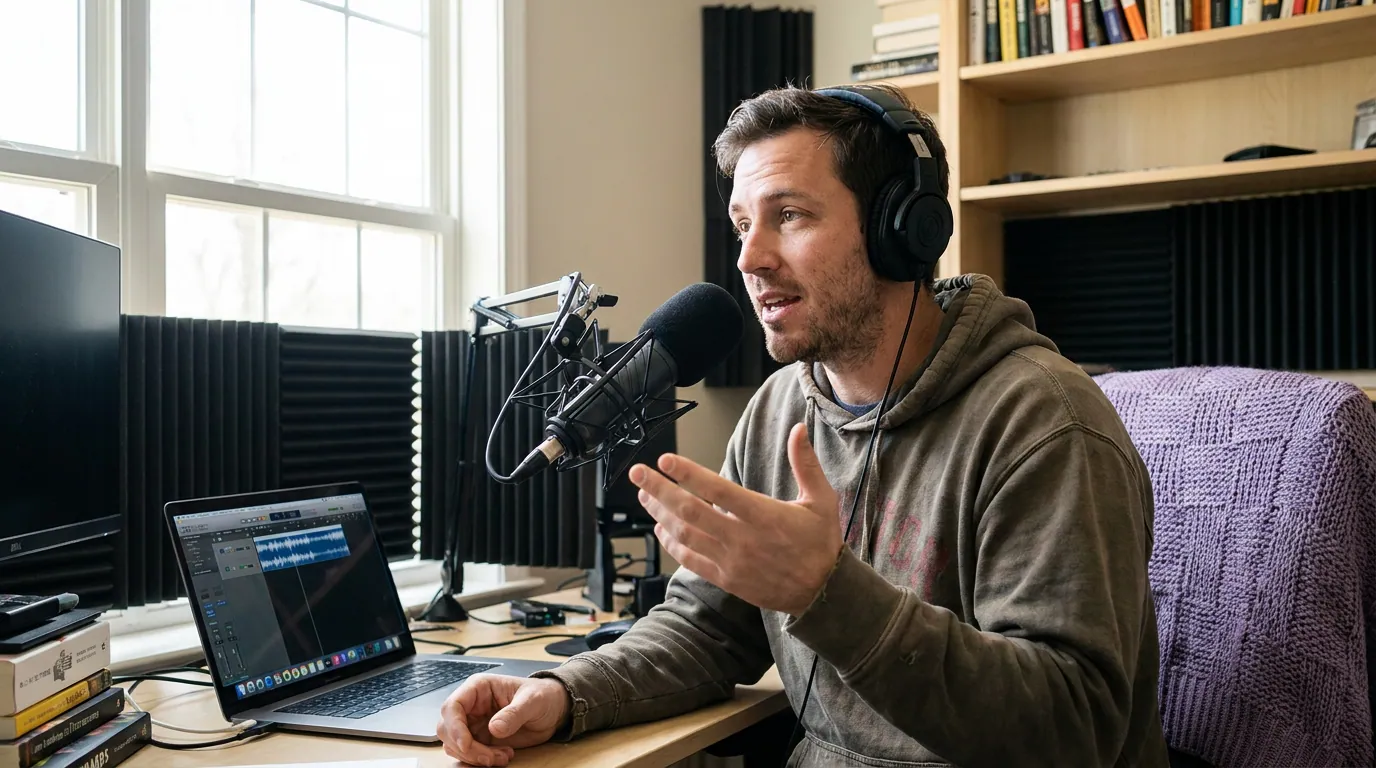
What actually makes a gaming podcast clip travel?
Reaction beats footage every time. The clips that travel are the ones where a host states a divisive opinion, defends a ranking, reacts live to news, or calls out a studio, moments that exist only because two people are talking, not because a game is on screen. Sort your episode by those four types, not by "exciting gameplay."
I call the hierarchy the Take Stack. The higher up the stack, the more a clip travels, because the higher tiers force the viewer to have an opinion back. The lower tiers inform; the higher tiers provoke. Provocation is what gets a stitch, a duet, and an argument in the comments, and argument is the rawest engagement signal there is.
1. The hot take, a divisive opinion stated as fact
The hot take is one host planting a flag: "Open-world games peaked in 2017 and everything since is filler." It travels furthest because it does two jobs at once, it states a position confidently and it implicitly dares the viewer to disagree. The disagreement is the distribution.
The cut rule: open on the claim, not the build-up. Start the clip on the sentence that states the position bare, "Here's the thing, live service killed the single-player budget", and trim everything before it. The first three seconds decide whether anyone stays, so the take itself has to be the first thing they hear and read in the caption. Let the defense of the take fill the rest of the clip, and let the comments fill with people defending the opposite.
2. The ranking debate, tier lists, GOAT picks, hills to die on
Ranking debates are the most reliably clippable gaming format that exists, because a ranking is an opinion structured as a list, and a list invites correction. "Top five Soulslike bosses," "the most overrated console of all time," "where this Zelda lands in the series", every one of these has a built-in army of people who rank it differently and will tell you so.
The cut rule: clip the disagreement, not the consensus. The boring stretch is the part where both hosts agree #1 is obvious. The clip is the part where one says "and number two is, " and the other says "absolutely not." Find the friction inside the ranking and start there. Put the contested pick in the caption verbatim so the mute-scroller knows instantly what to be mad about, since most social video is watched without sound.
3. The live news reaction, reacting to a drop or a delay
Gaming runs on a constant cycle of reveals, delays, patch notes, and acquisitions, and the reaction to that news clips far better than the news itself. Nobody needs your podcast to learn a game got delayed, they can read that. They watch your clip to see two people they trust react in real time: the groan, the "called it," the genuine excitement.
The cut rule: lead with the emotion, caption the context. The viewer scrolling needs to know in one second what you're reacting to, so the caption carries the news ("Reacting to the GTA 6 delay") while the clip opens on the unfiltered reaction. These clips are time-sensitive, the value decays within a day or two of the news, so this is the moment-type where speed from episode to posted clip matters most.
4. The dev / community callout, praising or roasting a studio
The callout is a host turning directly to a studio, a publisher, or the game's own community: "Whoever priced that battle pass should be ashamed," or, just as effective, "credit where it's due, that studio actually listened." Callouts travel because they tap an existing tribe, the fans who already feel that way rush to amplify, and the ones who don't show up to fight.
The cut rule: keep it pointed and keep it fair. A callout that names a specific decision ("the day-one patch was 90 gigs") lands harder than a vague rant, and it stays defensible. Roast the decision, not the people, and you get the reach without the liability. This is the one tier where editing for accuracy matters as much as editing for energy, clip the specific, verifiable complaint, not the exaggeration.
The rights trap: don't overlay gameplay you can't license
Here's the mistake that can quietly cost a gaming channel its monetization or get clips pulled: overlaying game footage, trailers, or another creator's gameplay onto your podcast clip because the talking-head shot feels "boring." The hosts' faces and voices are yours to post anywhere. Most game footage is not. Publishers and platforms enforce this unevenly, and "everyone does it" is not a defense when a Content ID claim lands on your clip.
The safe default is simple: the clip is the hosts. If you want visual variety, use footage you've actually licensed or that the publisher has explicitly cleared for creators, keep any incidental clip short and transformative (you're commenting on it, not replaying it), and never build the whole clip on borrowed footage. When in doubt, leave it out, a tight reaction shot with bold captions outperforms a rights-risky montage anyway.

Common mistakes clipping gaming podcasts
- Clipping gameplay instead of the take. The footage isn't yours and isn't your edge. Build the clip on the host reacting; if you show the game at all, make it brief and make it support the opinion.
- Burying the take. Starting on thirty seconds of "so we were talking about this earlier" wastes the three seconds that decide retention. Open on the claim itself.
- Going vague to stay safe. A callout with no specifics is forgettable; a callout naming the exact decision is both stickier and more defensible. Specific is safer than vague here, not riskier.
- Skipping captions. Game titles, patch numbers, and studio names are precise, and most social video plays on mute. A misspelled franchise name reads as "they don't actually play this," which is fatal in gaming. Proof every title. The same review discipline applies to picking the best AI-suggested clips before any go out.
- Letting hot takes age. A live news reaction is worth most within a day or two of the news. If your clip pipeline takes a week, the time-sensitive tier is dead on arrival, speed from episode to post is the whole point for that one.
Tools: surface the energy, set the take yourself
Any modern AI clipper will find a gaming episode's loud moments, laughter, raised voices, the spike when an argument starts, because detection models score on exactly that kind of intensity. How AI clip detection actually works breaks down why the energy spikes are what get flagged. What the model won't reliably do is know whether a loud moment is a take or just two people shouting over a respawn. That sorting, running each candidate through the Take Stack, is the human job.
QuickReel keeps generation, a frame-level timeline for trimming to the start of the take, captioning that you can proof for game titles, and multi-platform scheduling in one pass, which matters for the time-sensitive news-reaction clips. Opus Clip, Vizard, and Klap all surface strong candidate moments and give you an editable timeline too; the Take Stack and the rights decision apply to any of their output unchanged. The honest reality across all of them: most tools detect roughly the same moments, so the win is how few clicks it takes to get from a YouTube URL to a posted clip with the take opening the first second. The same reaction-first logic carries to clipping a comedy podcast without killing the punchline and to turning a business podcast into shareable clips, and the withhold-the-payoff discipline behind which true crime moments actually clip well is the same muscle, aimed at a different beat.