
Editing the Titles and Descriptions AI Writes for Clips


Treat every AI-suggested clip title and description as a first draft, never a final answer. Run each one through three quick edits, make it specific (name the number, person, or claim), add a curiosity gap without lying, and shape it to the platform you're posting on. Then strip the AI tells: the "Here's why," the colon-then-summary, the over-explained description. The clip selection might be the AI's best work. The words on top of it almost never are.
Most clip how-tos stop at picking the right moment and cutting it clean. They skip the text layer entirely, the title that sits above your Reel and the description underneath it. That's a mistake, because on a muted, fast-scrolling feed, the title is doing as much work as the first frame. A perfect clip with a flat AI title gets scrolled past. Here's how to fix the words.
Why the AI title is a draft, not a deliverable
AI clip tools are good at one thing and mediocre at another. They're genuinely strong at finding a self-contained, high-energy moment in a long episode, that's pattern recognition over transcript and audio, and it works. Writing the title for that moment is a different job, and it's where the same tools get generic, because they optimize for "describes the clip accurately" rather than "makes a stranger stop."
The result is a title that's correct and forgettable. "Talking about the future of AI." "Discussing how to grow a podcast." Accurate. Dead on arrival. The model summarized the content; it didn't sell the click. And the description is usually worse, a paragraph that re-explains the title, padded with hashtags it guessed at.
This matters because clip text is a discovery surface, not decoration. Social clips now drive podcast discovery more than friends and family do: 57% of listeners say they rely on social media for podcast recommendations, the first time it has passed personal referrals (InsideRadio, citing new survey data). The clip is how strangers find your show, and the title is the first word they read. One studio's client data puts clips at 20–40% of new audience with reach lifts of 2–5× for video shows (Podcast Studio Glasgow), a directional range from one source, not a platform audit, but the point holds: the front door is the clip, and the title is the sign on it.
This is the same logic behind picking the best AI-suggested clips with a repeatable rubric instead of fresh judgment each time, and behind reading the AI virality score honestly rather than trusting it blind. The AI hands you raw material. Your job is the edit.
The SCP rewrite: three passes, sixty seconds
Don't rewrite a title from scratch, that's slow and you'll stare at a blank box. Edit the draft the AI gave you through three filters in order. I call it the SCP pass: Specificity, Curiosity gap, Platform-fit. Most titles need all three; every title needs the first.
Pass 1, Specificity: name the thing
AI titles default to category words: "growth," "pricing," "mindset," "the future of." Replace the category with the concrete thing inside the clip. If the guest said they raised prices 40% and kept every customer, the title is "We raised prices 40% and lost zero customers", not "talking about pricing strategy." The number, the name, the exact claim is what makes a title belong to this clip and no other.
The test: could this title sit above a different clip from a different episode? If yes, it's too generic. A specific title is non-transferable by design.
Pass 2, Curiosity gap: open it, don't fake it
A good title makes the viewer need the answer the clip provides. "The one editing change that doubled our watch time" works because you want to know the change. The line you do not cross is the false promise. If the clip doesn't deliver the doubled watch time, you've made clickbait, and the cost is real: the viewer feels cheated, drops off fast, and the platform reads that drop-off as a low-quality signal.
The honest version of curiosity withholds the payoff but guarantees it's there. "Why we stopped posting daily", the clip must actually explain why. The bad version, "This changed everything," promises a payoff the clip can't keep. Tease the real thing; never invent one.
Pass 3, Platform-fit: same clip, different sign
A title written for YouTube Shorts is not the title for TikTok. Shorts and YouTube reward a slightly more searchable, topic-forward phrasing because so much YouTube viewing is intent-driven. TikTok and Reels reward a conversational, in-the-moment line that reads like a person talking. Instagram rewards a short hook with the detail pushed to the caption. The clip is identical; the words on top adapt.
| Platform | Title leans | Quick example |
|---|---|---|
| YouTube Shorts | Topic-forward, slightly searchable | "How this podcast got its first 1,000 subscribers" |
| TikTok / Reels | Conversational, in-the-moment | "He grew to 1,000 subs in 22 months, here's the one habit" |
| Short hook, detail in caption | "The 22-month subscriber climb" |
The time-to-1,000 figure here is real, by the way: the average YouTube channel takes about 22 months to reach 1,000 subscribers (BerryViral), and the commonly cited Social Blade estimate is that roughly 90% of channels never get there (directional; treat as an estimate, not an audit). Specific, sourced numbers make stronger titles than round guesses, and they hold up when a commenter checks.
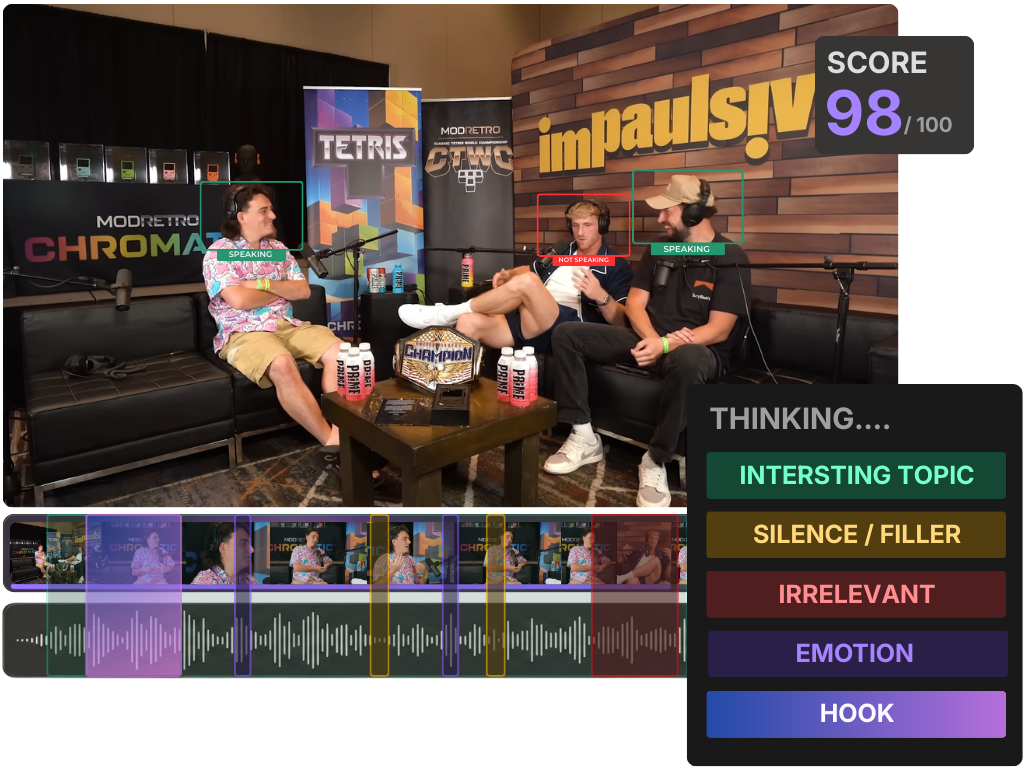
The AI title tells to strip out
Beyond the SCP rewrite, there's a set of fingerprints AI-written titles and descriptions leave behind. They read as machine-generated, and audiences are increasingly fluent at spotting them. Delete these on sight.
- The colon summary. "Pricing Strategy: How to Charge More." The colon-then-restate structure is the most common AI title shape. Cut the label before the colon and lead with the interesting half.
- "Here's why" / "Here's how" with no specifics. "Here's why most podcasts fail." Fine as a phrase, empty without the specific reason teased. Either name the reason or cut the framing.
- Over-explanation in the description. AI descriptions restate the title and then narrate the clip beat by beat. Nobody reads a play-by-play. One or two lines of context plus the source episode is plenty.
- Hashtag dumps. AI tools pad descriptions with a dozen broad hashtags (#podcast #motivation #success). Broad tags don't help discovery and they look spammy. Three to five relevant, specific tags beat twelve generic ones.
- Hedging language. "This might help you think about..." Clip titles don't hedge. State the claim. The hedge is the AI being safe; safe doesn't get the tap.
- Title-case everything. "How To Grow Your Podcast Fast" in full title case reads like a stock blog headline. Sentence case reads like a person. Match how the platform's natives actually write.
None of this means the AI draft is worthless. It means the draft is the 70%, the accurate summary, and your edit is the 30% that turns a summary into a hook. That ratio mirrors the wider reality that every AI clipper still needs human review: the model converges on the same moments most tools find, and the human wins or loses the clip in the layer on top.

Common mistakes when editing clip text
Editing the title but ignoring the description. The title earns the tap; the description earns the follow. A strong title with an AI-padded description leaves the conversion on the table. Trim the description to one line of context plus a clear pointer back to the full episode.
Writing one title for all platforms. Cross-posting the identical title everywhere is the fastest way to underperform on three platforms to save sixty seconds. Adapt pass 3. If you're batch-clipping a whole episode, build the platform variants in the same pass while the context is fresh.
Optimizing the title and forgetting the first frame. The title and the opening second of the clip have to agree. If the title promises a number and the clip opens on three seconds of throat-clearing, you've broken the promise before the words even register. For narrative cuts, where the end of the clip carries the suspense, the title sets the expectation the cut point has to pay off.
Believing a great title saves a weak clip. It doesn't, and pretending it does is dishonest. A sharp title on a flat moment buys a tap and a fast scroll-away, which trains the algorithm against you. Fix the clip selection first, knowing which moments actually clip well for your genre, then write the title for a clip that earns it.
Treating the AI draft as untouchable. Some people accept whatever the tool wrote because editing feels like extra work. It's the cheapest big-payoff edit in the whole pipeline. The clip took the AI minutes to find; the title takes you sixty seconds to fix, and it's the part the viewer reads first.
FAQ
Are AI-generated clip titles good enough to publish as-is? Usually no. They're accurate summaries, which is not the same as a title that earns a tap. The AI describes the clip; it rarely sells it. Run every draft through a quick rewrite, make it specific, open a real curiosity gap, and fit it to the platform, before you publish. The edit takes under a minute and returns more attention per second than anything else in the clip's text layer.
What makes a clip title actually work? Specificity first: a real number, name, or claim that belongs to this clip and no other. Then a curiosity gap that withholds the payoff without faking one. Then phrasing that matches the platform, searchable on YouTube, conversational on TikTok. A title that could sit above any clip from any episode is too generic to do its job.
How do I edit the AI clip description? Cut it down. AI descriptions restate the title and narrate the clip; readers want neither. Keep one or two lines of context, point to the full episode, and use three to five specific hashtags instead of a dozen broad ones. The description's job is to earn the follow after the title earns the tap.
Should the title be the same on every platform? No. The clip stays the same; the title adapts. YouTube Shorts rewards topic-forward, slightly searchable phrasing; TikTok and Reels reward a conversational, in-the-moment line; Instagram rewards a short hook with the detail in the caption. Writing one title for all three underperforms on each to save a minute.
Does a better title fix a weak clip? No, and it can backfire. A sharp title on a flat moment earns a tap followed by a fast scroll-away, which the platform reads as a low-quality signal and shows your next clip to fewer people. Fix the clip selection first, then write the title for a moment that already deserves attention.