
Open Loops: Tease a Payoff Without Losing Trust


An open loop promises a payoff in the first three seconds, then makes the viewer stay to collect it. To use one without losing trust, open the loop on a real moment that's actually in the clip, close it before your average drop-off second, and never promise something the payoff doesn't deliver. The tease earns attention; the payoff has to repay it, in full, on time.
The technique is borrowed from screenwriters, start a question the audience needs answered, hold it open, resolve it later. In short form the window is brutal. You open the loop in the hook and you have seconds, not acts, before you have to start closing it. Done right, an open loop is the difference between a clip people finish and a clip they leave at second four. Done wrong, it's clickbait, and clickbait works exactly once.
What is an open loop in a video clip?
An open loop is a deliberate gap between a question the hook raises and the answer the clip delivers later. You tell the viewer something is coming, a number, a confession, a turn, without giving it yet, so curiosity holds them through the middle. The loop "closes" when the payoff lands. The whole technique lives or dies on whether the payoff actually lands.
It's the same instinct as a cliffhanger, scaled down to a 30-second clip. "I lost $40,000 in one afternoon, and it was the best thing that ever happened to me" opens two loops at once: how, and why was it good. The viewer can't resolve either without watching. That tension is the curiosity gap, the distance between what you know and what you've been promised you'll know.
Why bother? Because the opening seconds decide the clip. Clipping practitioners call the first three seconds "absolutely critical" (castmagic), and the widely repeated reason is a Facebook/Meta figure: about 65% of viewers who clear the first three seconds go on to watch at least ten (via EnterpriseTube, directional secondary data, not a platform-audited law). Clearing those three seconds is the hinge the rest of the watch swings on, and an open loop is one of the most reliable ways to spend them, because it doesn't just state a hook, it makes the viewer want the rest. For the full menu of openers that earn that window, see hook openers that make people stop scrolling.
The payoff-timing model: open early, close before the drop-off
Open the loop inside the first three seconds, then close it before your average drop-off second, the point in the clip where most viewers leave. If your clip typically bleeds viewers around second 12, the payoff has to arrive before second 12, not at the end. A loop that stays open past the moment people quit isn't a tease. It's a broken promise nobody stayed to see kept.
Most creators get the open right and the close wrong. They front-load a great question, then bury the answer at the back of the clip to "maximize watch time." On a long video that works. On a clip, viewers don't owe you patience, they leave the second the tension outlasts their interest, and your payoff plays to an empty room. The fix is to find where they actually leave and close the loop in front of it.
You find the drop-off second by reading the retention curve on the clip. The first cliff, usually a sharp fall in the first five to ten seconds, is where weak clips die. On a clip with an open loop, watch what happens to that cliff: a loop that holds tension flattens it, and the payoff lands while most viewers are still there. If the cliff is still steep, your loop opened a question the viewer didn't care enough about to wait for, and no amount of payoff timing fixes a tease nobody wanted.
The four steps
- Open the loop on something real. Pull the line where the guest sets up a turn, "the thing nobody tells you is," "here's where it went wrong," a number teased before it's said. The loop has to point at a payoff that exists in the clip. If you're manufacturing the question, you're writing clickbait.
- Close it before the drop-off second. Trim so the answer arrives before viewers typically leave. For a 30-second clip that usually means the payoff lands by the 12–18-second mark, not at second 28. Check the real number on your own clips.
- Make the payoff bigger than the tease. The answer should feel like more than the question promised, not less. If the tease is "the best decision I ever made" and the payoff is "I started waking up earlier," you've underpaid, and underpayment is what trains people to stop trusting your hooks.
- Leave no loop unclosed. If you opened two questions, the clip has to close both, or close one and earn the click to the full episode for the other, honestly. A loop you never intend to close is a lie with a play button.
The line between an honest tease and clickbait
A tease is honest when the payoff is in the clip and is at least as good as promised. It's clickbait when the hook promises a payoff the clip doesn't contain, or sells one thing and delivers a weaker, different thing. The difference isn't how dramatic the hook is, drama is fine. It's whether the clip keeps the specific promise the hook made.
This matters more for clips than almost any other format, because a clip is the front door to your show, 57% of listeners now rely on social media to find podcasts, edging out friends and family (54%) for the first time (Inside Radio), and the report credits video clips as the format driving that shift. A clickbait clip might win one view. But the person who felt cheated doesn't subscribe, doesn't watch your next clip, and the algorithm reads the early exit and stops showing it. The feed is more crowded with clipped podcast content than ever, so trust is the only thing that compounds. Run every loop through this test before you post.
The cleanest way to stay honest is to write the hook after you've picked the payoff, not before. Find the strongest moment in the clip first, then write a tease that points straight at it. When you write the hook first and go hunting for a payoff to match, you end up stretching a mediocre moment to fit an oversized promise, and that's the exact gap viewers punish. More on that failure pattern in why your podcast clips get no views.
Common mistakes with open loops
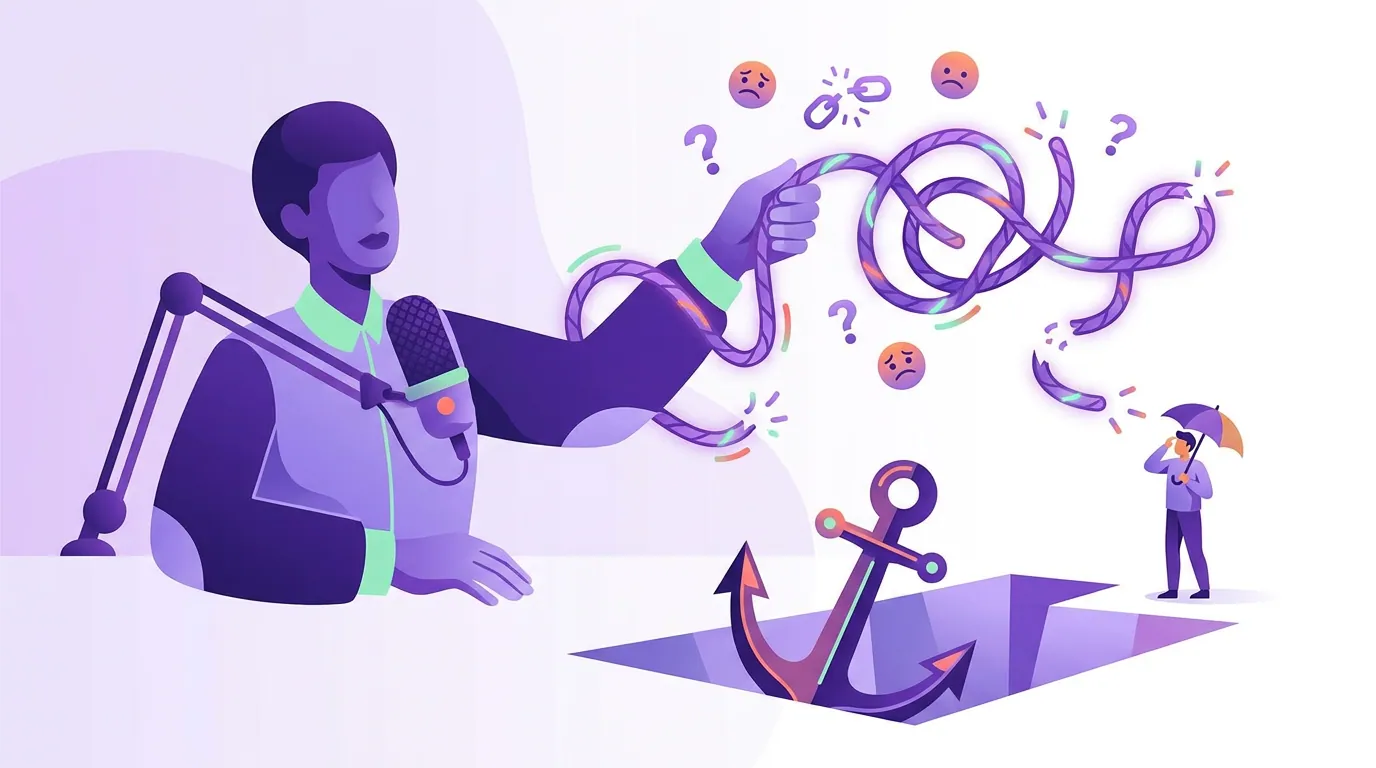
- Closing the loop too late. The payoff sits at the end "for retention," but the retention curve already collapsed at second eight. Move the answer in front of the drop-off second, even if it means a shorter clip.
- Opening a loop with no real payoff. "What he said next shocked everyone" over a mild observation is the clickbait classic. If the next line isn't shocking, don't promise shock. The viewer's disappointment is measurable, it shows up as an early exit and a dead clip.
- Teasing in audio only. Most of the feed is watched silently, Digiday reported about 85% of Facebook video played muted back in 2016 (Digiday; publisher-reported and directional, but the direction hasn't reversed). If your loop is a spoken tease with no on-screen text, most viewers never hear it open. Put the loop in the caption or a text hook, not just the voice. The mechanics of that opening window are in what to put in the first three seconds of a clip.
- Stacking too many loops. Two open questions can work; five is noise. The viewer can hold one or two unresolved threads, not a tangle. Open the strongest loop, close it, and let the rest be bonus.
- Reusing the same tease structure on every clip. "You won't believe what happened" stops working when it's your whole feed. Vary the loop, sometimes a number, sometimes a confession, sometimes a contradiction, so regulars don't pattern-match their way to a scroll.
Tools: where the timing gets set
Placing a payoff before the drop-off second is a trim decision plus, often, a caption that carries the loop on mute. Both are editorial, and both are faster when the transcript, the timeline, and the captions live in one view, you scrub to the payoff line, pull your out-point past it, and type the tease into the opening caption without an export-reimport loop.
An AI clipper speeds the first half by surfacing the charged moments, but it won't decide where to close your loop or whether the tease is honest, those are judgment calls. Knowing what AI clip detection actually catches, like sentiment spikes and topic shifts, versus what it can't judge, whether a payoff repays its tease, tells you exactly where to step in. Same when you're picking the keepers from a batch of suggestions: for each one, find the payoff, then check the hook points at it and lands in time. QuickReel keeps clip generation, an editable timeline, captions, and text overlays in one pass, so setting the payoff's position and writing the loop into the caption is a scrub-and-type; Opus Clip, Vizard, and Klap all support trimming and captions too, and the timing model works identically in any of them.