
LinkedIn vs X for B2B Podcast Clips

For a B2B podcast, post the credibility clip on LinkedIn and the sharp-claim clip on X, they are not the same cut. LinkedIn's slow, high-intent feed rewards a guest looking like the smartest person in the room over days; X's fast feed rewards one quotable line that earns replies in the first hour. Cut for the feed, not the file.
The mistake almost every B2B show makes is treating the two as interchangeable: render one 60-second clip, post it to both, move on. It underperforms on each because the platforms run on opposite physics. One ranks on how long people linger; the other ranks on how fast people react. This guide gives you a decision rule for which moment goes where, a same-episode "two cuts" framework, and the guest-credibility angle that turns a clip into your next booking.
LinkedIn or X, which is better for B2B podcast clips?
Neither wins outright; they do different jobs, so a serious B2B show uses both. LinkedIn is the better platform for building authority and getting your guest's network to notice the show, because posts there accumulate reach over days. X is the better platform for entering live conversations and earning reshares fast, because a single sharp line can travel through quote-posts in an afternoon.
The practical answer depends on your goal for a given episode. If you want a senior guest to feel proud enough to reshare, and to say yes the next time you ask, lead with LinkedIn. If you want to ride a trending topic your episode happens to address, lead with X. Most weeks you do both, with two different cuts of the same conversation.
Why the two feeds reward opposite cuts
The split comes down to how each feed decides what to show. LinkedIn's 2026 ranking leans heavily on dwell time, how long someone actually lingers on a post, and rewards content with a long tail, where a strong post keeps surfacing for days rather than spiking once and dying (meet-lea, LinkedIn algorithm 2026; marketing analysis, directional, not an official LinkedIn disclosure). X runs the inverse model: a post's useful life is measured in minutes, with one widely cited analysis putting a tweet's half-life around 18 minutes, if a post does not earn interaction inside that first window, the system effectively stops surfacing it (SocialEcho, X best time to post 2026; marketing analysis, directional). Replies are what reset that clock.
That structural gap changes the edit. A LinkedIn clip is watched slowly, often saved, sometimes returned to, so a complete, substantive thought that holds attention for 45 seconds is exactly what the feed wants. An X clip is watched fast, mid-scroll, in a feed that forgets it within the hour, so the front-loaded claim that triggers an immediate reply is what travels. Same guest, same conversation, two different in- and out-points.
The same-episode "two cuts" framework
You record one conversation; you publish two clips with different jobs. Run each episode through this split before you export anything.
- Find the credibility moment for LinkedIn. Scan the transcript for the single most defensible, specific claim your guest makes, a contrarian position with reasoning, a concrete "here's exactly how we did it," a number they can stand behind. That is the 45 seconds a director-level professional would reshare with the comment "good point." Cut it as a complete thought, square or 4:5, captions burned in, the insight in the first line.
- Find the reaction moment for X. Scan the same transcript for the line that would make someone hit reply, a sharp opinion, a counterintuitive take, a one-sentence reframe of a topic people argue about. It can be the same idea as your LinkedIn clip, but cut tighter: open on the claim itself, keep it under 60 seconds so it auto-loops in the timeline, and let the thread supply the context.
- Cut them differently, on purpose. The LinkedIn cut can breathe, a setup line, the claim, a beat of payoff. The X cut starts on the payoff. The LinkedIn caption is a clean takeaway; the X post is a hook that invites disagreement. If you find yourself exporting one file for both, you have not finished the framework.
- Match the format to the feed. Square (1:1) or 4:5 for LinkedIn, where desktop viewing is common and full vertical shows padding. Landscape, square, or vertical all work on X, but keep it under 60 seconds for the loop. The specifics live in posting podcast clips on LinkedIn that get watched and podcast clips on X: specs and reach.

A decision rule: which moment goes where
When you are staring at a list of AI-suggested moments and deciding where each belongs, use this. It maps the kind of moment to the platform whose feed physics reward it.
| Moment in the episode | Best home | Why the feed rewards it |
|---|---|---|
| Guest's defensible, specific claim | High dwell time, save-worthy, builds authority over days | |
| A framework, set of steps, or numbers | LinkedIn (carousel pairs well) | Professionals save and reshare to look informed |
| A sharp, arguable opinion | X | Triggers replies fast, travels via quote-posts in the first hour |
| A timely take on a trending topic | X | Velocity feed rewards riding a live conversation |
| A funny or surprising exchange | Neither first, try TikTok | Entertainment lands better on a culture-and-sound feed |
The one rule under all of it: on LinkedIn you clip the smartest 45 seconds; on X you clip the most reply-worthy line. Smart and arguable are not the same edit. A claim that reads as authoritative on LinkedIn can read as bait on X, and a line that sparks a thread on X can read as flippant in a professional feed. Choose deliberately.
The guest-credibility angle (the part that books your next interview)
Here is the lever most B2B shows ignore: a great LinkedIn clip is a recruiting tool for future guests. When you clip a senior guest's strongest moment, caption it cleanly, and tag them, you hand them a polished asset they will reshare to their own network, and the next person you want to interview sees their peer looking sharp on your show. The clip does double duty: it grows your audience and it lowers the friction on your next pitch.
This matters because of where B2B audiences now come from. 57% of listeners rely on social media for podcast recommendations, the first time it surpassed friends and family (InsideRadio, 2026). For a business show, the recommendation that converts is a respected professional resharing your guest's insight to their feed, which is exactly what a credibility-first LinkedIn clip is engineered to earn.
The honest caveat: a clip that travels is reach, not a subscriber. Short-form clips are estimated to drive 20–40% of new-audience acquisition for video shows (Podcast Studio Glasgow; single-studio figure, directional), but views convert only when the episode link is one tap away, in the LinkedIn first comment, in the X reply, never buried in a bio.
Common mistakes posting B2B clips to both platforms
- Posting the identical file to both. It is sized wrong on at least one and cut wrong for at least one. Re-export square for LinkedIn; trim tighter and front-load the claim for X.
- Putting the link in the post body. LinkedIn demotes posts with outbound links in the main text, and X throttles posts that send people off-platform. Drop the episode link in the first comment (LinkedIn) or a reply (X).
- Clipping for entertainment on LinkedIn. The funny moment that earns replies on X often falls flat in a credibility feed. Pick the smart 45 seconds for LinkedIn, the arguable line for X.
- Letting it sit as a bare upload on X. A clip alone is a dead end on the fast feed; wrap it in a short thread so replies keep it alive past the first 18 minutes. The feed is flooded with podcast snippets across TikTok, Instagram, X, and YouTube, so a bare upload competes with everyone else's bare uploads, and the thread is what makes yours stop the scroll.
- Skipping the tag on LinkedIn. Not tagging your guest forfeits the reshare to their network, the single highest-return move a B2B clip has.
Tools for cutting both versions efficiently
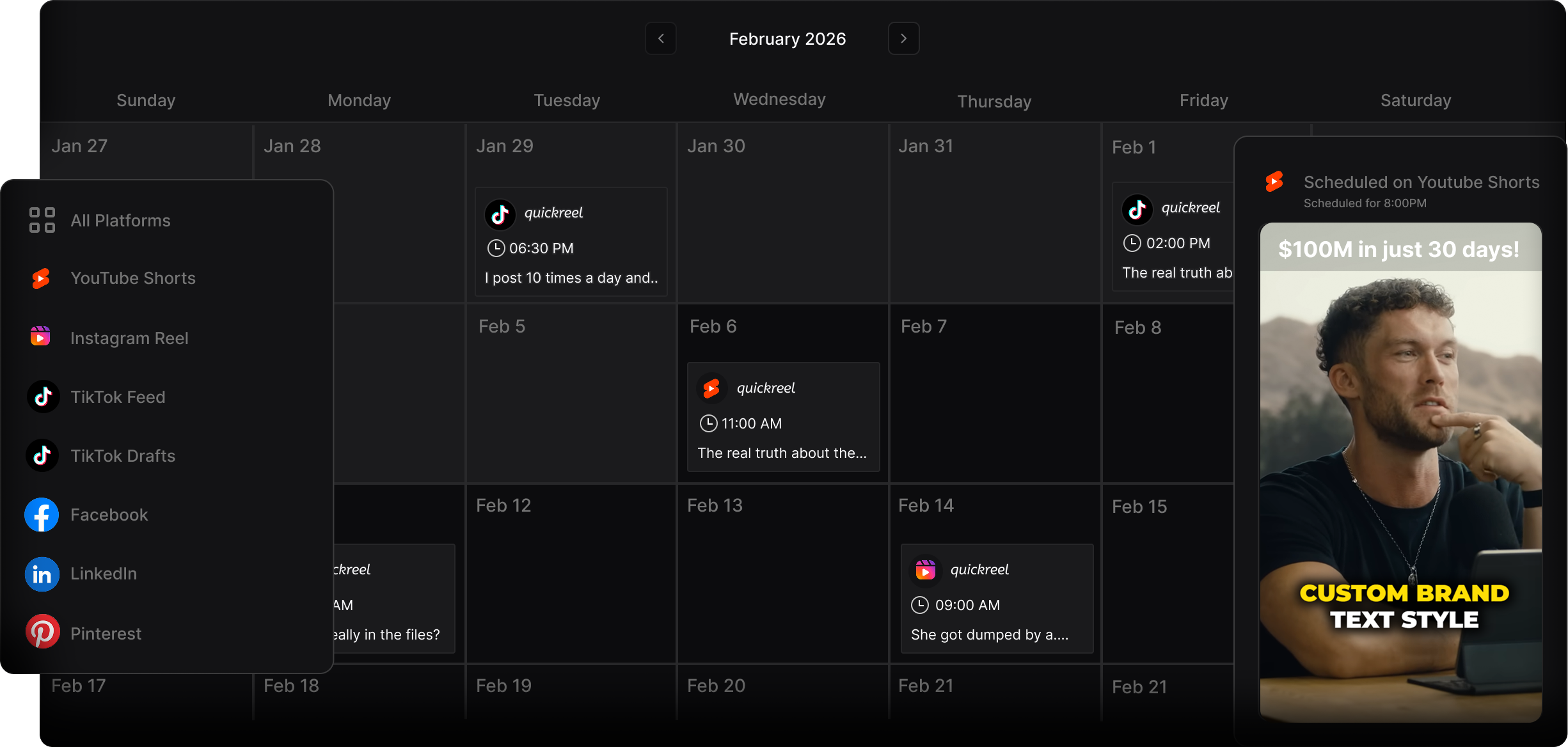
The reason most shows post one file to both is that cutting two versions by hand is tedious, different aspect ratios, different in-points, separate caption proofreading. An AI clipper removes the volume problem: it surfaces the candidate moments and auto-captions them, so you spend your time on the platform calls rather than the timeline. QuickReel fits this for B2B, it auto-captions, reframes with speaker tracking, exports square and vertical, supports 20+ languages and 12+ caption styles, and schedules to both platforms from one place (current pricing starts at a $9 Starter tier). The honest line that applies to every AI clipper, not just ours: plan to review roughly 20–40% of what it suggests, and the human judgment, which moment is credible, which is arguable, which goes where, stays yours. When you are scoring the AI's candidates, how AI clip detection actually works explains what the model is deciding, and how to pick the best AI-suggested clips walks through choosing the credibility cut and the reaction cut from the same batch.