
Best Podcasts in India: Why Language Decides Reach

The best podcasts in India aren't ranked by genre. They're ranked by two decisions the host made first: which language to record in, and whether to be a video show or an audio show. Get those two right and a true-crime show, a finance show, and a horror show all reach the same scale. Get them wrong and the best content in the country stays small.
That is the part a generic "top Indian podcasts" list misses. In a market where India is the world's third-largest podcast audience yet only about 12% of Indians currently listen (Podcast Pulse / Ideabrew, via Storyboard18), the room to grow is enormous, but the door is language, and the building is YouTube and Spotify, not Apple Podcasts. Below is who's winning, why language sets the ceiling, why the platform split is different here than in the West, and a decision map you can actually use.
What are the most popular podcasts in India right now?
The top tier is creator-led and splits along language. On Spotify Wrapped India 2025, Figuring Out with Raj Shamani ranked #1 most-streamed creator-led podcast, The Desi Crime Podcast #3, and The Ranveer Show (Ranveer Allahbadia, "BeerBiceps") #4. Regional horror like the Bengali-language Pretkotha landed at #9, and WTF is with Nikhil Kamath sits in the same English-and-Hindi tier (The Reelstars on Spotify Wrapped 2025).
Notice what those names have in common and what they don't. The business-and-mindset cluster, Ranveer, Kamath, Shamani, is built on long-form celebrity and expert interviews, the format that travels best on video. The biggest single moments of 2025 came from that cluster. Nikhil Kamath hosted Prime Minister Narendra Modi on People by WTF (Episode 6, released January 10, 2025), Modi's first podcast appearance (Business Standard). Raj Shamani's roughly four-hour Vijay Mallya episode passed 20 million YouTube views within four days of its June 2025 release (Storyboard18). Those are political and media firsts, but they're also a format lesson: a famous guest plus a camera is the most reliable scale engine India has.
The shows below the headline names tell the more interesting story. The Desi Crime Podcast, run by Aryaan Misra and Aishwarya Singh since 2021, built a #3-streamed show out of weekly cases from India, Pakistan, and Nepal, narrative craft, not celebrity, the same edge the best true-crime hosts build on. The Habit Coach with Ashdin Doctor wins on short, audio-first self-help. And the regional-language shows climbing the chart are the clearest signal of where growth is coming from. As The Reelstars put it, the Spotify Wrapped India list shows independent creators now outperforming traditional formats across business, crime, horror, and regional fiction.
For the show-by-show detail, hosts, histories, episode archives, the directory lives on fanpage.wiki: The Ranveer Show, WTF is with Nikhil Kamath, and The Desi Crime Podcast. This page is the analysis; that's the reference shelf.
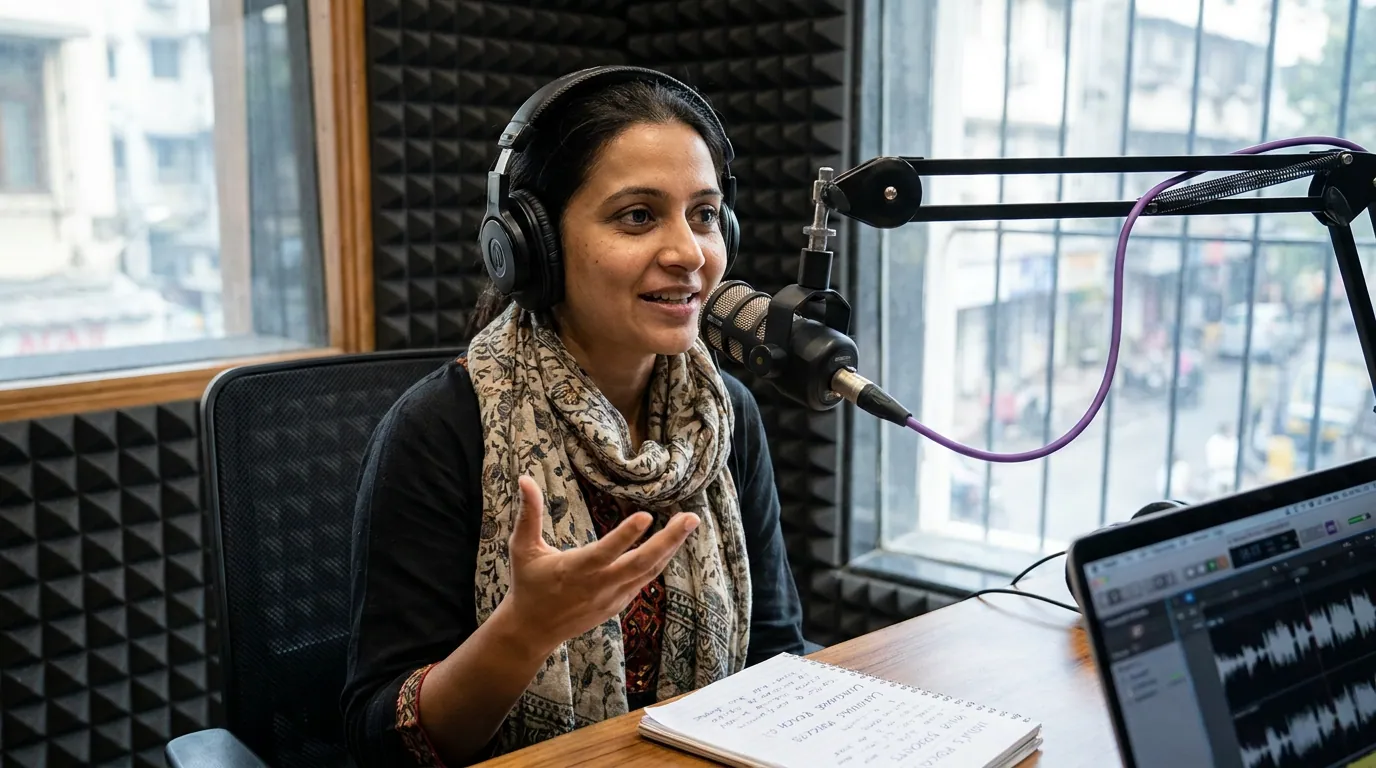
Why does language decide reach in India?
Because India isn't one audience, it's a stack of language audiences, and the size of yours is set before you record. Hindi is the single biggest at an estimated ~45% of the market and English a much smaller ~12%, with regional languages projected to make up as much as 85% of content (IBEF; Astute Analytica).
The most useful number in this whole market is a growth rate, not a share. When Kuku FM, the regional audio platform, added Tamil, Telugu, Kannada, and Malayalam content, it saw roughly 60% month-on-month growth in those languages, about double the rate of Hindi (GrowthX). The platform now spans 14 languages and has grown to 10 million-plus paid users, raising $85 million in late 2025 at a reported ~$500M valuation (3one4 Capital). The plain reading: Hindi is the biggest pool, but the regional pools are filling fastest, because tens of millions of new listeners come online wanting content in the language they think in.
That changes the strategic question. In the US or UK, you pick a niche. To see how differently that plays out, the habits behind the top US shows are about genre and consistency, and the UK top 10 looks nothing like the US because of public-broadcaster history, but both are single-language games. In India, you pick a language first and a niche second, because your language sets your maximum audience and your competition. A Marathi finance show competes with a handful of Marathi finance shows; an English finance show competes with the world's best, including imports.
Why is the platform map different in India?
Because the default app isn't Apple Podcasts, it's YouTube and Spotify, and the two do different jobs. YouTube is where Indian shows get discovered and go viral; Spotify is where listeners become loyal. Apple Podcasts, the chart that defines "top" in the West, is a minor player in an Android-first, cheap-data market.
The Entrepreneur India year-in-review put it cleanly: YouTube "became a vehicle for getting noticed, for going viral, and for brand discovery," while Spotify "became the vehicle for developing a loyal customer base, for repeat listening." The Desi Crime team described the same division from the listener's side, "Spotify is primarily for consuming, and YouTube only serves as a means of discovering" (Entrepreneur India).
This isn't only an India story, YouTube passed a billion monthly podcast viewers globally in January 2025 (Variety), but India leans harder into video than almost anywhere, because the phone is the first screen and video is the native format on it. There's a regional twist: audio-first platforms like Kuku FM win the vernacular, data-light, often offline-download listener that YouTube's video-heavy feed serves less well. So the real platform map has three lanes, not two: YouTube for video discovery, Spotify for English-and-Hindi loyalty, and the Kuku-FM-style audio apps for regional reach into smaller towns.
The practical caveat: none of these platforms publishes clean, comparable listener data, and the market-size forecasts here come from research firms (Astute Analytica values the market at $560M in 2024, projected toward $4.2B by 2033). Treat them as directional. What is solid is the behaviour pattern, discover on video, retain on audio, because the operators themselves describe it the same way.

The India decision map: language × platform
Here is the part no generic list gives you. Your two first decisions, language and primary platform, point to a strategy. Find your row, then build for it.
| If you record in… | Lead platform | The play |
|---|---|---|
| English | YouTube first, Spotify for loyalty | Compete on production and guests; you're against global imports, so go niche or go celebrity |
| Hindi | YouTube + Spotify both heavy | The biggest single pool; win on video virality and a weekly habit |
| Tamil / Telugu / Bengali / Marathi + others | Audio apps + YouTube clips | Less competition, fastest growth; serve the language natively, distribute clips for discovery |
A few honest reads of that map. English looks prestigious and pays the best ad rates, but it's the smallest pool and you're competing against The Joe Rogan Experience and every global show on the same feed, which is why the English winners here are either celebrity-driven (Kamath) or sharply niche. Hindi is the volume play: the largest audience, served by the most mature creator ecosystem, where the business shows worth studying as a new host have proven the interview format scales on video. Regional is the contrarian bet: smaller absolute audience per language, but the growth curve is steepest and the competition thinnest, and a Bengali or Tamil show that owns its language can become the default in a way an English show never will.
One thread runs through all three rows: clips. India discovers on video and on social, and the pattern shows up in research elsewhere too, 57% of US podcast listeners now name social media as how they find new shows, edging out friends and family (54%) for the first time, per a Coleman Insights and Amplifi Media study of 1,000 consumers (reported by InsideRadio). For a regional Indian show with no YouTube algorithm tailwind, a short captioned clip is the discovery layer you build yourself. For a Hindi show, it's the viral surface. For English, it's how you compete for attention against bigger budgets. The map's three lanes converge on one tactic.
What India's chart teaches every market
Strip away the names and India makes a point that holds everywhere: the structural decisions beat the content decisions. Australia's chart is shaped by a small home market that forces shows to export; Canada's by a giant English-speaking neighbour next door. India's is shaped by language fragmentation and a phone-first, video-first audience. In each case the winners didn't out-produce everyone, they read their market's structure correctly and built for it.
For India specifically, the takeaway is unusually clean. Decide your language with eyes open about the pool and the rivals it puts you against. Pick the platform lane that matches it. And treat clips not as marketing but as the discovery engine. With only about 12% of Indians listening so far (Storyboard18), the job isn't to win the existing audience, it's to be the clip that pulls a new one in.
Frequently asked questions
What is the number one podcast in India? On Spotify Wrapped India 2025's most-streamed creator-led list, Figuring Out with Raj Shamani ranked #1, The Desi Crime Podcast #3, and The Ranveer Show (BeerBiceps) #4 (The Reelstars). "Number one" depends on the chart: YouTube view counts, Spotify streams, and aggregator rankings each crown different shows, and they shift month to month.
Are most popular Indian podcasts in Hindi or English? Both lead at the top, but the market underneath is bigger in Hindi. Hindi is estimated at around 45% of the market and English around 12%, with regional languages making up the largest combined share (IBEF). The marquee shows skew Hindi and English; the fastest growth is in regional languages.
Which platform do most Indians use for podcasts? YouTube for discovery and Spotify for repeat listening, with audio-first apps like Kuku FM strong in regional languages. Apple Podcasts, the dominant chart in the West, is a minor player in India's Android- and data-first market (Entrepreneur India).
Are regional-language podcasts growing in India? Yes, faster than Hindi or English. Kuku FM saw roughly 60% month-on-month growth when it added Tamil, Telugu, Kannada, and Malayalam, about double its Hindi rate, and now operates across 14 languages with 10 million-plus paid users (GrowthX; 3one4 Capital).
Why is podcast penetration in India still low if the market is so big? India is the world's third-largest podcast market by audience size, but only about 12% of Indians currently listen (Storyboard18). The population is so large that even a small share is huge, and it means most of the potential audience is still being reached for the first time, usually through a clip rather than a podcast app.